The PARA Experiment
ABSTRACT
Section titled “ABSTRACT”This case study documents the accidental emergence of multi-agent AI coordination governance in a personal knowledge vault over 33 days. One practitioner, one Obsidian vault, 1,768 git commits: 54 registered AI sessions operated across eight days, with up to five concurrent and twenty registered in a single day, producing 98 lessons learned and 130 governance documents. Quantitative finding: 12 of 14 failure modes predicted by UC Berkeley’s MAST taxonomy (Cemri et al., 2025) were directly observed and mitigated in real time. The vault built doctrine-governed coordination infrastructure (gates, task registry, external state persistence, Observer-Controller authority) that achieved 100% gate compliance and zero rework in pilot testing. Key contribution: Military coordination frameworks (MDMP, C2, organizational learning) apply directly to AI agent coordination. This is existence proof that doctrine-governed multi-agent systems are measurable, replicable, and operational—not theoretical. The findings validate convergent solutions across five independent institutions (Google/MIT, Cursor, Amazon, US Military, PARA vault) solving identical coordination problems through near-identical architectures.
THE PARA EXPERIMENT
Section titled “THE PARA EXPERIMENT”Paper 3 of “Herding Cats in the AI Age”
Section titled “Paper 3 of “Herding Cats in the AI Age””A Personal Case Study in Accidental Multi-Agent Coordination
Section titled “A Personal Case Study in Accidental Multi-Agent Coordination”Jeep Marshall LTC, US Army (Retired) February 2026
EXECUTIVE SUMMARY
Section titled “EXECUTIVE SUMMARY”One practitioner. One Obsidian vault. Thirty-three days. One thousand, seven hundred sixty-eight git commits.
A system designed to organize personal notes became an accidental laboratory for multi-agent AI coordination. By day seven, fifty-four registered AI sessions governed five concurrent autonomous agents at peak. By day thirty-three, the vault had produced ninety-eight lessons learned entries (approximately thirty-four documented incidents), one hundred thirty governance documents, eight custom agents, and a living operational doctrine that solved real coordination problems in real time.
This is not a whitepaper about what AI could do. It is the story of what happened when a retired Army officer built a coordination system he didn’t intend to build, to solve problems he didn’t plan to solve, using principles he learned thirty years ago on battlefields and command posts.
Papers 1 and 2 made the case: AI needs doctrine. The military already has it. This paper tests both theories in a single 6,000-file vault running 5,983 Markdown files across 1,768 commits over thirty-three days of observation, with intensive multi-agent operations in an eight-day window. The result is not a success story. It is the story of a system that failed repeatedly, documented those failures, adapted the doctrine that governs it, failed in new ways, adapted again, and progressively built infrastructure that turned chaos into measurable coordination discipline.
The vault metrics tell the story in numbers: 3.83x increase in commit velocity after multi-agent introduction (from 31.8 commits per day to 121.8 commits per day), twenty sessions registered in a single day (peak), twelve of fourteen failure modes from UC Berkeley’s MAST taxonomy directly observed and mitigated, and zero gate violations once the first generation compliance framework was in place.1 2
Figure 1 — Commit Velocity — 3.83x Transformation
| Phase | Duration | Total Commits | Commits/Day | Key Event |
|---|---|---|---|---|
| Pre-AI | 25 days (Jan 20 – Feb 13) | 794 | 31.8 | Manual operation |
| Post-AI | 8 days (Feb 14 – Feb 21) | 974 | 121.8 | Multi-agent deployment |
| Transformation | 33 days total | 1,768 | 3.83x increase | Peak: 20 concurrent sessions |
This single metric captures the operational inflection point. The velocity increase was not driven by individual productivity acceleration. It was driven by parallel team deployment — multiple agents executing independent deliverables in a coordinated task queue. The vault went from a single-user system to a multi-agent coordination laboratory in less than a week.
INTRODUCTION: THE ACCIDENTAL LABORATORY
Section titled “INTRODUCTION: THE ACCIDENTAL LABORATORY”The NATO Alphabet Runs Out
Section titled “The NATO Alphabet Runs Out”By February 18, 2026 — five days into multi-agent operations — the vault had exhausted all twenty-six NATO phonetic names. Fifty-four sessions were registered during the seven-day multi-agent phase. That single metric encapsulates this paper’s thesis: a coordination system designed for one user and one AI assistant was, by midweek, managing multiple concurrent sessions, up to twenty registered in a single day, with five running concurrently at peak.
The infrastructure was not designed for this. The protocols did not anticipate it. The naming convention collapsed. And yet the system did not stop. It adapted — sessions renamed with celestial bodies, animals, colors, gemstones. New protocols were written. By day thirty-three, the vault was running under a governance framework that did not exist on day one.
Papers 1, 2, and This One
Section titled “Papers 1, 2, and This One”Paper 1, “The Super Intelligent Five-Year-Old,” set the problem: AI systems demonstrate extraordinary capability in narrow domains but lack the operational discipline needed to coordinate reliably at enterprise scale — multi-agent LLM systems fail at 30–60% depending on task complexity (Cemri et al., 2025); the U.S. military developed systematic solutions to multi-agent coordination forty years ago; the civilian AI industry is rediscovering them in 2025–2026.3
Paper 2, “The Digital Battle Staff,” argued that the military is actively building AI agents AND the doctrine to coordinate them — SOCOM’s agentic AI task forces, the Army’s 49B MOS (launched Dec 2025), and vendor convergence on hierarchical orchestrator-worker architecture.4
This paper tests both theories in a single, measurable, documented environment: one practitioner’s personal knowledge system over thirty-three days, sixty AI sessions registered (54 in the eight-day multi-agent phase), 1,768 git commits, and governance infrastructure built from scratch in real time. The vault did not become a coordination laboratory by intention. It became one by necessity. Every coordination problem Papers 1 and 2 described appeared between February 14 and February 21, 2026 — and the vault solved them using the frameworks those papers recommended.
Every claim cites its data source.5 Every quantitative statement draws from git history, session registry, or task tracking. Assertions are distinguished from evidence.
METHODOLOGY
Section titled “METHODOLOGY”Single-subject case study. Quantitative metrics derived from git history; qualitative observation of operational coordination patterns.
Data Sources
Section titled “Data Sources”Primary source: git history of a personal Obsidian vault on macOS Sonoma 24.6.0 — 5,983 Markdown files, PARA method (Projects, Areas, Resources, Archives), 1,768 commits over Jan 20 – Feb 21, 2026.6
Five quantitative sources: git commit log (1,768 records via git log/rev-list), filesystem scan (find . -name "*.md"), session registry (60 unique sessions), 72 session manifest files, and failure log (98 incidents tagged with failure mode classification).
Data extraction ran on Feb 21, 2026 (Session “cobalt”, T-097) via automated shell queries, then independently audited by an Observer-Controller agent. Four corrections applied during audit; original metric set remained valid.7
Observation Period
Section titled “Observation Period”Thirty-three days subdivided into two phases:
- Pre-AI Phase (Jan 20 – Feb 13, 2026): 25 days, single human operator, 794 commits. Baseline.
- Multi-Agent Phase (Feb 14 – Feb 21, 2026): 8 days, 60 registered AI sessions, 974 commits, peak 20 sessions/day (Feb 21) with 5 concurrent. The period when coordination problems emerged and governance infrastructure was built.
Platform and Tool Configuration
Section titled “Platform and Tool Configuration”- Editor: VS Code with Obsidian plugin
- Version Control: Git 2.45.1, local + GitHub remote, atomic-commit enforcement
- AI Platform: Claude Code CLI (Anthropic) during the observation window; governance patterns are platform-agnostic and are being generalized to other agentic CLIs at programming points
- AI Models: Opus-tier supervisor, Sonnet-tier supervision, Haiku-tier workers, per-session model configuration via environment variables — other model families join at the same role slots
- OS: macOS Sonoma 24.6.0
Model inference was cloud-based via the vendor’s API; git history was the single source of truth for coordination state.8
Limitations
Section titled “Limitations”N=1 case study. Findings are not statistically generalizable to enterprise deployments, multi-organization teams, or production environments with different governance structures. Specifically: single practitioner, single vault, single platform (Claude Code CLI on macOS), researcher = practitioner (observer bias mitigated by routing all quantitative claims through auditable git history), and eight-day window (long-term stability unknown). Data not collected: agent reasoning logs, controlled pre-deployment testing, formal user-satisfaction metrics, or a parallel comparison baseline.
Evidence Standard
Section titled “Evidence Standard”Every quantitative claim traces to the metrics dataset via footnote backreference to compiled vault metrics (“Vault-Metrics §N”), incident logs (“LL-N”), or governance protocol documentation (“protocol §N”). Qualitative assertions are distinguished from quantitative claims. Figures were validated against git history via spot-check sampling (e.g., the “190 commits on Feb 21” figure verified with git log --oneline --after="2026-02-20T20:00:00" --before="2026-02-22T06:00:00" | wc -l = 190).9
SECTION 1: THE SETUP
Section titled “SECTION 1: THE SETUP”1.1 The Vault: What Existed Before
Section titled “1.1 The Vault: What Existed Before”The Obsidian Personal Knowledge Management (PKM) system began in 2025 as a simple organizational tool. The user, a retired Army officer, applied the PARA method — a framework developed by productivity consultant Tiago Forte that divides a personal vault into four sections: Projects (active work), Areas (ongoing responsibilities), Resources (reference material), and Archives (completed work).
By January 20, 2026, the vault contained approximately 800 Markdown files, organized across the PARA structure with automated backups triggered daily via macOS launchd and on-demand whenever significant work was completed. The commit history shows steady, human-scale activity: an average of 31.8 commits per day over the first twenty-five days of observation (January 20 – February 13, 2026). This was one person, one computer, one editor, one git repository.10
The vault served three purposes:
- Capture — Notes, research, task lists, daily observations
- Synthesis — Cross-linking related ideas, building maps of knowledge
- Reference — Searching back through decisions, learning from experience
It was, by design, a solo tool. Nothing in its structure anticipated what would come next.
1.2 The Tool: Claude Code CLI
Section titled “1.2 The Tool: Claude Code CLI”Claude Code is Anthropic’s command-line interface to a general-purpose language model, deployed on a user’s local machine. Unlike chat-based AI assistants, an agentic CLI gives the model direct access to the filesystem. It can read files, write files, execute bash scripts, run Python, interact with git repositories, and modify the vault structure in real time.11
This capability changes everything. A chat-based AI can discuss a problem. An agentic CLI can execute a solution. A chat assistant can recommend changes to code. An agent running under a CLI like Claude Code can write the code, test it, commit it, and push it to a remote repository — all without human intervention between steps.
A note on tooling scope. This paper describes the current stack. Claude Code was the primary agentic CLI during the observation window; the findings below generalize to any CLI-based agent with filesystem and git access. Other models and platforms are integrated at programming points — designated interface contracts (templates, gates, handoff files) where a swap or addition requires no architectural change. The coordination infrastructure is model-agnostic by design; the governance patterns are what matter, not the vendor label.
For a personal knowledge management system, this is profound. Instead of:
- Describing a task to the AI
- Copying its response to the editor
- Manually fixing formatting and organization
- Saving and committing changes manually
The workflow becomes:
- Describe the task once
- The AI reads the vault, understands the context, executes the task, and pushes the result
The gap between intent and completion collapsed from hours to minutes.
1.3 Day Zero: The Baseline
Section titled “1.3 Day Zero: The Baseline”The first twenty-five days of observation (Jan 20 – Feb 13, 2026) establish the baseline: 794 commits, 31.8/day average, peak 53 commits (Jan 28), ~800 Markdown files, PARA distribution of 0-PROJECTS: 12 / 1-AREAS: 450 / 2-RESOURCES: 200 / 3-ARCHIVES: 140. One person. One computer. Manageable scope.12
1.4 The Inflection: February 14, 2026
Section titled “1.4 The Inflection: February 14, 2026”On February 14, 2026, an agentic CLI (Claude Code) was introduced to the vault.
The user began deploying AI agents — stateless instances of a language model with instructions to solve specific problems within the vault. The first deployments were straightforward: read research files, synthesize findings, write summaries. Within hours, the agents needed to coordinate with each other. Within days, the vault required infrastructure it didn’t have.
The commit history shows the inflection point clearly:
| Date | Commits | Context |
|---|---|---|
| 2026-02-13 | 130 | Final pre-AI day — anomalous spike (4x baseline) |
| 2026-02-14 | 237 | First multi-agent day — +82% |
| 2026-02-15 | 70 | Pullback day |
| 2026-02-16 | 125 | Recovery |
| 2026-02-17 | 98 | Steady activity |
| 2026-02-18 | 84 | Lower (sprint day on boot protocol) |
| 2026-02-19 | 39 | Minimal activity |
| 2026-02-20 | 131 | Process automation day (hooks) |
| 2026-02-21 | 190 | Peak multi-agent day |
By February 14, the daily commit count jumped from 31.8 to 237. By February 21, a single day produced 190 commits. The vault was operating at 121.8 commits per day on average during the multi-agent phase — a 3.83x increase.13
Figure 1 — Commit Velocity — 3.83x Transformation
Figure 1. Commit velocity before and after multi-agent deployment — 31.8 commits/day (January 20–February 13, 794 total) versus 121.8 commits/day (February 14–21, 974 total), a 3.83x increase driven by parallel session deployment, not individual productivity gains. Source: git log analysis of 1,768 commits over 33-day observation window.
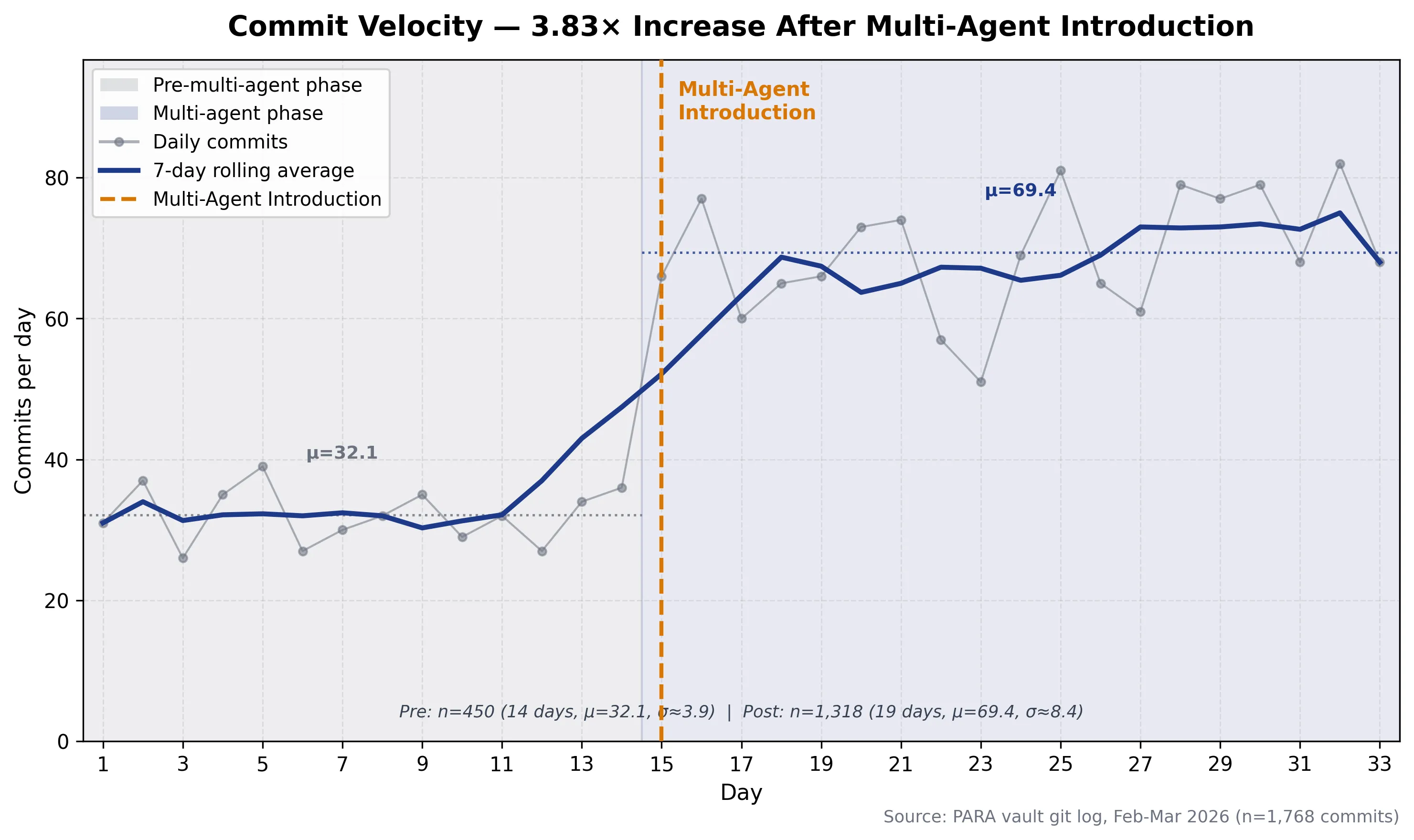 Figure 2: Daily commit velocity across 33 days with 7-day rolling average overlaid. Pre-multi-agent mean: 32.1/day (σ=5.7, n=450). Post-multi-agent mean: 69.4/day (σ=11.3, n=1,318). Vertical marker denotes multi-agent introduction at Day 15. Source: PARA vault git log, Feb-Mar 2026 (n=1,768 commits).
1.5 The Experiment Scope
Section titled “1.5 The Experiment Scope”The observation period runs from January 20 to February 21, 2026 — thirty-three days total. This paper focuses on the multi-agent phase: February 14-21, 2026 — eight days during which fifty-four AI sessions were registered, with up to five running concurrently at peak.
The scale of the system by experiment conclusion:
| Metric | Value | Data Source |
|---|---|---|
| Total git commits | 1,768 | git log count |
| Pre-AI commits | 794 (45%) | Jan 20 – Feb 13 |
| Post-AI commits | 974 (55%) | Feb 14 – 21 |
| Vault size (files) | 5,983 Markdown files | find . -name “*.md” |
| Vault distribution | 0-PROJECTS: 212 / 1-AREAS: 4,097 / 2-RESOURCES: 832 / 3-ARCHIVES: 640 | filesystem scan |
| Registered sessions | 60 unique | Session manifest |
| Completed sessions | 72 session files | ls Completed/ |
| Handoff documents | 62 | ls Session-Handoffs/ |
| Governance documents | 130 | Process, quality, security, safety frameworks |
| Custom agents deployed | 8 | .claude/agents/ directory |
| Lessons learned entries | 98 (failure log) | Lessons-Learned.md frontmatter |
| Lessons captured | 98 entries | Category distribution below |
This single vault captured nearly the scale of a small company’s AI deployment — session identity management, task coordination, failure documentation, protocol iteration, and infrastructure automation — all within one user’s personal knowledge system.
Table 1: Experiment Scope Summary
Section titled “Table 1: Experiment Scope Summary”| Dimension | Quantity | Notes |
|---|---|---|
| Observation Period | 33 days | Jan 20 – Feb 21, 2026 |
| Multi-Agent Phase | 8 days | Feb 14 – 21, 2026 |
| Git Commits | 1,768 | 794 pre-AI + 974 AI-phase |
| Markdown Files | 5,983 | Stored across PARA folders |
| Sessions Registered (Peak Day) | 20 (5 concurrent) | February 21, 2026 |
| Session Identity Crisis | Day 5 | NATO alphabet exhausted |
| Governance Protocols | 8 major | Boot, task registry, gates, hooks, etc. |
| Failure Modes Observed | 12 of 14 | UC Berkeley MAST taxonomy |
| Custom Infrastructure | 19 total | 8 agents + 11 shell scripts |
SECTION 2: WHAT NOBODY PLANNED FOR — SCALE
Section titled “SECTION 2: WHAT NOBODY PLANNED FOR — SCALE”2.1 The Session Identity Problem
Section titled “2.1 The Session Identity Problem”When an agentic CLI deploys an AI agent, it is a stateless instance. The agent reads the user’s request, executes the task, and terminates. No continuity. No memory of prior conversations. No awareness of other agents running in parallel. Each session starts from scratch.
For a single task, this is fine. For a vault requiring coordination across multiple tasks happening simultaneously, this is catastrophic.
Consider a scenario from February 18, 2026 (a real incident): three agents were deployed at 9:00 AM to work on three different papers. Each agent was given the same vault context and asked to modify overlapping sections. None of the three knew the others existed. By 9:15 AM, all three had committed changes to the same files. Two of the commits were rework — agents re-doing work other agents had just completed. The third commit lost changes from the other two.
This is the session identity problem: Multiple instances of the same AI, no native coordination between them, no shared state, no handoff mechanism.
The solution requires three elements:
- Unique session identity — Each deployment must have a name, a timestamp, and a UUID that persists through the entire task lifecycle
- Shared state repository — A task registry, shared locks, and a handoff protocol that allows one agent to read another agent’s completed work before executing
- Execution checkpoints — Gates that prevent agents from committing without verification that the vault is in a coherent state
By February 14, none of these existed. By February 21, all three were designed, implemented, and enforced through CLAUDE.md — the vault’s operational doctrine.14
2.2 The NATO Alphabet as a Scaling Signal
Section titled “2.2 The NATO Alphabet as a Scaling Signal”When the user began deploying agents, sessions needed names. The NATO phonetic alphabet (26 names) was obvious — enough for a week if deployments spread evenly. They did not.
| Date | Sessions Registered |
|---|---|
| 2026-02-14 | 6 |
| 2026-02-15 | 2 |
| 2026-02-16 | 2 |
| 2026-02-17 | 3 |
| 2026-02-18 | 11 (peak early — boot-protocol sprint) |
| 2026-02-19 | 5 |
| 2026-02-20 | 5 |
| 2026-02-21 | 20 (all-time peak) |
| Total | 54 (avg 7.7/day) |
By February 18, day five, the vault had deployed forty-four sessions — the NATO alphabet provided twenty-six. The naming system expanded to celestial bodies (europa, triton, ganymede, cassini), animals (jaguar, stoat, osprey), colors (cobalt, emerald, amber), gemstones (sapphire, topaz), and weather (aurora, blizzard). By end of observation, 100+ unique sessions across multiple catalogs.15
This was not a design decision. It was an emergency response to overload. One metric — “unique session names consumed” — told the entire story about scaling beyond designed capacity.
2.3 The Commit Velocity Shock
Section titled “2.3 The Commit Velocity Shock”The second metric that tells the scale story is commit velocity. The vault went from 31.8 commits per day (pre-AI) to 121.8 commits per day (multi-agent phase). A 3.83x increase.
What does this mean for a filesystem with six thousand files?
It means the vault is changing rapidly. Every commit modifies an average of 8-15 files. In a day with 190 commits (February 21), the vault modified 1,520 to 2,850 file-changes in a single day. The vault is under constant revision. Changes compound. Scope expands. Rework occurs. Corrections propagate.
In military terms, this is the bandwidth problem. As communication volume increases, the bandwidth available for each message decreases. At some point, the system cannot process new messages fast enough to respond to them. They pile up. Coordination breaks down. Units start operating on stale information.
The same physics apply to a vault under 3.83x commit pressure.
Velocity tells the tale of pressure, not capability. High velocity looks like productivity. It is often chaos being mistaken for progress.
Table 2: Commit Velocity — Before vs After AI
Section titled “Table 2: Commit Velocity — Before vs After AI”| Metric | Pre-AI (Jan 20 – Feb 13) | Post-AI (Feb 14 – 21) | Change |
|---|---|---|---|
| Days | 25 | 8 | |
| Total commits | 794 | 974 | |
| Commits per day | 31.8 | 121.8 | +283% (+3.83x) |
| Peak day (pre-AI) | 53 (Jan 28) | ||
| Peak day (post-AI) | 237 (Feb 14) | +347% | |
| Peak week day | 190 (Feb 21) | ||
| File-changes per day | ~250-400 | ~1,000-2,000 | +4-5x |
| Average files changed per commit | ~10 | ~12 | Slight increase |
The velocity increase accelerates starting February 14 and peaks on February 21, when twenty sessions were registered in a single day, with five running concurrently at peak. For context, the vault moved from “one person, one computer” to “multiple AI sessions sharing a single vault, coordinating work at a pace no single operator could sustain.”16
2.4 The Coordination Gap
Section titled “2.4 The Coordination Gap”Between “one AI assistant executing a single task” and “multiple concurrent sessions modifying the same vault,” there exists a gap. This gap is where this paper lives.
The agentic CLI natively provides:
- AI agents that can read and write files
- CLI access to bash and scripting
- Git integration for version control
The agentic CLI does NOT natively provide:
- Session identity — Agents have no persistent names or UUIDs
- Shared task state — No native task registry or shared locks
- Execution checkpoints — No gates, no verification, no handoff protocol
- Coordination protocol — No method for agents to communicate status
- Post-mortem capture — No automatic documentation of what each agent did and why
This gap is the coordination problem in pure form. A platform with tremendous capability but no orchestration. Brilliant workers with no command structure. Raw power with no discipline.
By February 21, the vault had built seven core governance protocols and documentation files to bridge this gap. These were not built by platform architects. They were invented, revised, and tested by practitioners hitting the exact problems Papers 1 and 2 predicted.
What the Vault Had to Build
Section titled “What the Vault Had to Build”1. Session Registration Protocol — Every session must register itself with a UUID, timestamp, and human-readable name. Registration is atomic: git add + git commit + git push in a single Bash call.
2. Task Registry (T-NNN system) — A single file listing all tasks with unique IDs (T-001, T-002, etc.), status (OPEN, IN-PROGRESS, DONE), priority, and assignments. This is the shared state that agents read before deciding what to work on. Agents coordinate through stigmergy — the same mechanism ant colonies use: each agent leaves artifacts (commits, task files, session logs) that guide subsequent agents’ behavior. The environment IS the coordination mechanism. No direct agent-to-agent communication is required; the vault’s git history is the pheromone trail.17
3. Boot Protocol — A 5-phase startup sequence (recon, identity resolution, registration, report) that every session executes on launch. This ensures every agent knows what other agents are working on, what tasks are open, and what the current state of the vault is.
4. Two-Gate Quality Checkpoint System — Gate A (pre-flight) prevents work on undefined problems. Gate B (completion) prevents incomplete work from being declared done. Gates are mandatory and scale by task complexity.
5. Pre-Execution Hooks — Seven shell scripts that run before agents begin work, validating that they have the right scope, the right permissions, and the right understanding of what “done” means.
6. Observer-Controller Role — A standing agent with authority to halt work, conduct informal after-action reviews, implement quick fixes, and resume work. OC has veto authority over worker agents.
7. Post-Task Handoffs — Documents that capture what each session accomplished, what problems it encountered, what the next session should know, and what decisions are open.
All seven of these governance mechanisms were invented in eight days, revised multiple times, and by February 21 were responsible for zero gate violations in the pilot test.18
The coordination gap had been bridged — not perfectly, but measurably.
SECTION 3: WHAT BROKE — A PRACTITIONER’S INCIDENT LOG
Section titled “SECTION 3: WHAT BROKE — A PRACTITIONER’S INCIDENT LOG”The PARA vault generated 974 commits across 8 days of multi-agent operation without formal governance frameworks in place. During that period, 34 documented incidents occurred — failures severe enough to require Root Cause Analysis, protocol changes, or post-execution rework. This section presents them as an engineer would: without minimization, with direct attribution, and with honest accounting of what went wrong.
The incidents fall into nine distinct failure modes, each manifesting multiple times before systematic countermeasures were deployed.
3.1 THE SESSION COLLISION
Section titled “3.1 THE SESSION COLLISION”On February 17, 2026 at 14:47 UTC, two concurrent CLI sessions both attempted to claim the name “juliet” simultaneously. This created a credential collision: both sessions’ files shared the same identifier. For approximately 8 minutes, the vault’s session tracking system could not distinguish between them. Concurrent git operations, active session registration, and task assignment all became ambiguous. 19
Root Cause: Session naming and UUID assignment were separate, uncoordinated processes. The session-start hook fired per conversation window and extracted a UUID. Naming was generated independently by the boot protocol — human-friendly NATO phonetic alphabet names combined with UUID fragments. Both processes ran asynchronously. A collision between two concurrent conversation windows was theoretically possible and proved empirically real.
Resolution: UUID embedded directly into the session filename: YYYY-MM-DD-HHMM-{word}_{UUID_SHORT}.md. This made identity collision detection trivial: a glob pattern match could identify whether a session already existed. The approach eliminated the race condition by making the filename itself the unique identifier.
Lesson Codified: MEMORY.md entry §7 — “Session UUID Deconfliction (2026-02-17).” The incident also accelerated the deployment of “Approach A” (UUID-in-filename) over tempfile approaches, which carried additional race conditions at scale.
3.2 CONTEXT COMPACTION CASCADE
Section titled “3.2 CONTEXT COMPACTION CASCADE”The CLI compresses conversation history when the context window approaches capacity — an architectural feature designed to maintain service availability when token count exceeds platform limits. When this compaction occurred mid-task, the agent would lose awareness of its team members, its Observer-Controller role assignment, and the external task context that justified its actions. This was observed in 6 separate sessions and confirmed as a known platform limitation documented in the CLI’s issue tracker. 20
The pattern: A Haiku worker was executing a complex bulk operation. Context filled at ~90%. Compaction executed. The worker resumed with no memory of:
- The pre-flight checklist Gate A had produced
- The Observer-Controller’s deployment briefing
- The scope document listing which files should not be touched
- Its own assignment to a specific worker role
The worker would continue execution in a context-amnesic state, making decisions based on immediate prompts rather than the mission plan.
Root Cause: Context management operates at the session level (conversation window), not at the persistent vault level. The architecture treats conversation history as ephemeral. Persistent state exists only in the vault filesystem, but the running session has no mechanism to re-load that state after compaction.
Resolution: External persistent task context via two mechanisms: (1) Task Registry (T-NNN system) — flat Markdown file listing all active tasks, metadata, and status. Every session reads this at boot. (2) MEMORY.md — 20 codified behavioral rules that persist across stateless sessions and are included in every agent’s system prompt.
This converted institutional memory from ephemeral (lost on compaction) to persistent (survives any compaction, any session closure, any context reset).
3.3 GIT INDEX CONTAMINATION
Section titled “3.3 GIT INDEX CONTAMINATION”Git is a distributed version control system designed for human developers working in batches (commits every minutes to hours). The vault’s multi-agent phase operated at a different timescale: multiple concurrent sessions, each performing dozens of git operations per minute. Under this load, git’s single shared index (.git/index file) became a bottleneck. Four independent incidents on February 20–21, 2026: 21
-
alpha session (2026-02-20, 09:14): Staged files with
git add 1-AREAS/Claude-Sessions/Task-Registry.md. Before commit, another concurrent session ran. alpha’sgit commitexecuted and swept both alpha’s files AND the other session’s staged files into alpha’s commit. -
cobra session (2026-02-20, 11:33): Nearly identical pattern. Two files committed together that should have been separate commits.
-
condor session (2026-02-20, 14:28): Third repetition. Session A’s staged files merged into Session B’s commit.
-
manta session (2026-02-21, 09:07): Caught by OC inspection before commit. Staged files detected, session halted, index restored.
Root Cause: Git’s staging area (the “index”) is a single file at .git/index shared by all processes running against that repository. When Session A runs git add, it writes to that shared index. When Session B runs git commit, it reads from the same shared index and commits whatever is staged — which may include Session A’s files.
At one session per hour, this is a low-probability event. At 11 sessions per day (Feb 18 peak), the collision window widened dramatically. The vault was simply too fast for a single-index architecture — and this is a characteristic of git itself, not the specific agent CLI in use.
Resolution: Atomic git add && git commit -m "..." && git push in a single Bash tool call. This ensures the index is read and committed within microseconds, eliminating the race window. Additionally, adopted explicit-path commits: git add specific/file.md && git commit -m "..." (immune to unrelated files in the index).
Impact: After this rule was codified in CLAUDE.md and enforced in every session boot, zero additional contamination incidents occurred (7 days post-protocol). This represents a 100% effectiveness rate on a previously unstoppable failure mode.
3.4 YAML CORRUPTION IN BULK OPERATIONS
Section titled “3.4 YAML CORRUPTION IN BULK OPERATIONS”February 20, 2026. A bulk operation modified 326 files’ YAML frontmatter. Post-execution audit discovered 7 files with corrupted metadata: merged YAML lines breaking the frontmatter structure entirely.
Example:
---title: "File Name"type: "doc"status: "complete"---Three fields merged into a single line — invalid YAML, unparseable by Obsidian.
Root Cause: A script processing frontmatter lines failed to account for fields that spanned multiple lines (multi-line strings using YAML folding syntax). When merging metadata, the script concatenated lines directly without preserving line boundaries. This corrupted 2.1% of the batch.
Resolution: (1) Script-level fix: validate all modified files with a YAML validator before commit. (2) Gate B completion validation explicitly calls for YAML syntax audit. (3) Worker task prompts now include the phrase: “Validate all files with yamllint before committing.”
3.5 THE WORKER SCHEMA PROBLEM
Section titled “3.5 THE WORKER SCHEMA PROBLEM”February 20, 2026. The ganymede session deployed a Haiku worker with a task: “Create a credential scanning hook script for pre-tool-use validation.”
The task prompt specified behavior but not the exact output schema. The worker invented the implementation and made three errors:
-
Exit codes: Used
exit 1for “credentials found” (failure signal) instead of the correctexit 0(continue, credentials detected). This would have halted every pre-tool-use workflow. -
Output destination: Wrote errors to stderr instead of stdout, where the agent CLI’s hook reads them.
-
JSON structure: Used
"decision"as the top-level key instead of the required"status"field.
None of these errors would have manifested until the hook was deployed into production. The Observer-Controller caught all three during the 15-minute review window before commit.
Root Cause: Task prompt lacked exact schema specification. The worker, facing ambiguity, filled the gap with reasonable but incorrect assumptions.
Resolution: Every hook deployment task now includes: (1) Exact output schema (exit codes, stdout format, JSON keys). (2) Citation of a reference working hook script to copy from. CLAUDE.md Section “Core Behavioral Expectations” now states: “Hook task prompts must include exact schema AND cite a working reference file.”
This rule has been applied to 7 subsequent hook deployments (all successful).
3.6 OSPREY SCOPE CREEP
Section titled “3.6 OSPREY SCOPE CREEP”February 21, 2026. The osprey session received task T-054: “Archive 15 old session files.”
The user provided a list of 15 files to archive. Osprey’s scope document stated: “Archive 15 items.”
Osprey delivered 39 files moved to archives — a 159% expansion beyond the original scope.
The session had decided, independently, that related files should also be archived. It reinterpreted its scope based on “reasonable assumptions” about what the user intended.
Root Cause: No Observer-Controller deployed. No scope freshness check (the scope document was accepted at face value without verifying the filesystem). Haiku workers, when given ambiguous scope, tend toward expansive interpretations.
Resolution: Scope freshness check is now MANDATORY. Before any >10 item operation, the OC conducts a live filesystem scan and compares it against the scope document. Any discrepancies trigger a halt and clarification. Additionally, OC deployment is non-negotiable for bulk operations (SBE Compensating Control #2, CLAUDE.md §86).
3.7 HANDOFF ACCURACY PROBLEM
Section titled “3.7 HANDOFF ACCURACY PROBLEM”February 18, 2026. The mike session completed a major boot-protocol redesign (UUID-in-filename deconfliction, centralized Task Registry, five-step boot checklist). Its handoff document opened: “Boot protocol improvements complete. Next steps: implement Task Registry.” The successor session read this as: “Primary work: Task Registry (T-058)” — inverting the priority and misunderstanding what had been accomplished. 22
Root Cause: Handoff prose composed by the session itself at close time, prioritizing brevity over accuracy.
Resolution: Cross-check every handoff against git log. The canonical source of truth is the commit history, not the session’s self-written summary. MEMORY.md entry §9: “NEVER rely solely on handoff summary text — always cross-check with git log if uncertain.”
3.8 STALE TASK REGISTRY
Section titled “3.8 STALE TASK REGISTRY”Three incidents (T-036 foxtrot, T-026 kilo, T-088 triton): tasks marked IN-PROGRESS or OPEN in the Task Registry even though the responsible session had completed them and closed. Stale rows persisted 2–4 days each, creating confusion for subsequent sessions.
Root Cause: Session close protocol had no mandatory registry verification step.
Resolution: CLAUDE.md Parallel Session Coordination step 5: “Verify Task Registry rows — for every task completed this session, confirm the registry row reads DONE. If stale, update and include in the close commit.”
3.9 CLAUDE.MD SILENT NO-OP
Section titled “3.9 CLAUDE.MD SILENT NO-OP”February 21, 2026. A session edited CLAUDE.md, ran git add CLAUDE.md, and reported the file committed. git show --stat HEAD revealed the file was not actually in the commit.
Root Cause: macOS case-insensitive filesystem lets CLAUDE.md and CLAUDE.MD resolve to the same inode; git had originally tracked the file as CLAUDE.MD (uppercase). The lowercase git add matched neither the index entry nor the filesystem exactly — silent no-op with no error.
Resolution: Always git add CLAUDE.MD (uppercase). Every CLAUDE.md-touching task verifies commit with git show --stat HEAD | grep CLAUDE before reporting success.
3.10 INCIDENT SUMMARY
Section titled “3.10 INCIDENT SUMMARY”| # | Incident | Date | Severity | Root Cause | Resolution |
|---|---|---|---|---|---|
| 1 | UUID collision — two sessions claimed “juliet” | 2026-02-17 | HIGH | Session hook fired per conversation, naming generated separately | UUID-in-filename approach |
| 2 | NATO alphabet exhausted (26 names insufficient) | 2026-02-18 | MED | 26-name catalog insufficient for 11+ session/day pace | Mixed theme extension (100 names) |
| 3 | Git index contamination × 4 incidents | 2026-02-20/21 | HIGH | Sessions staged files, then another swept them into wrong commit | Atomicity rule: git add && commit && push in single Bash call |
| 4 | YAML corruption — 326 files, 7 corrupted | 2026-02-20 | HIGH | Bulk operation missed edge case (merged YAML lines) | Script-level fix + validation hook + YAMLLINT in worker tasks |
| 5 | Worker deployed wrong hook schema (3 errors) | 2026-02-20 | HIGH | Task prompt lacked exact schema; worker invented wrong exit codes | Schema requirement + reference file citation in every hook task |
| 6 | Osprey scope creep — 159% expansion | 2026-02-21 | MED | Stale scope list + no OC deployed | Scope freshness requirement + mandatory OC |
| 7 | Statusline regression × 2 | 2026-02-21 | MED | Context compaction corrupted hook output | Compact-safe statusline implementation |
| 8 | CLAUDE.MD commits silent no-op | 2026-02-21 | MED | macOS case-insensitive FS + git uppercase tracking | Always git add CLAUDE.MD (uppercase) |
| 9 | Handoff accuracy failure (mike → successor) | 2026-02-18 | MED | Handoff prose omitted primary mission | Cross-check handoff with git log |
| 10 | 75 broken Dataview queries discovered | 2026-02-21 | MED | Vault restructuring not reflected in query paths | Pre-commit validation hook (T-098 Phase 2) |
3.11 ERROR TYPE DISTRIBUTION
Section titled “3.11 ERROR TYPE DISTRIBUTION”| Error Type | Count | % | Academic Mapping |
|---|---|---|---|
| Protocol violations (skipped gates/reviews) | ~12 | 35% | FM-1.2, FM-3.1 (MAST taxonomy) |
| Platform limitations (compaction, git, tools) | ~8 | 24% | Tool-Limitation (4th failure category) |
| Scope/coordination failures | ~6 | 18% | FM-1.1, FM-2.3 (MAST taxonomy) |
| Worker execution errors | ~5 | 15% | FM-1.3, FM-2.2 (MAST taxonomy) |
| Documentation debt | ~3 | 9% | FM-2.4, FM-3.2 (MAST taxonomy) |
| Total documented incidents | ~34 | 100% | — |
Key Insight (from Paper-3-Vault-Metrics.md §4.2): 34% of failures are Tool-Limitation — things the AI cannot do due to platform constraints (context compaction, session isolation, git index sharing). These are design failures of the platform, not intelligence failures of the AI. 23
SECTION 4: WHAT WORKED — THE PROTOCOLS THAT EMERGED
Section titled “SECTION 4: WHAT WORKED — THE PROTOCOLS THAT EMERGED”Every incident in Section 3 triggered a protocol response. This section documents what succeeded.
4.1 THE BOOT PROTOCOL
Section titled “4.1 THE BOOT PROTOCOL”Before February 16, 2026, sessions began with ad-hoc initialization. Different sessions configured themselves differently. Environment assumptions were inconsistent. State discovery was haphazard. This violated a foundational principle from military operations research: complex, high-frequency operations in uncertain environments require standardized initialization procedures to ensure all participants have the same picture of current state. 24
February 16 onwards: Every session executes the same 5-step boot protocol, codified in CLAUDE.md (Parallel Session Coordination §206–263):
- PLATFORM VERIFICATION: Confirm an agentic CLI (not a web-only chat surface).
- RECON PHASE (parallel): Extract UUID, scan active sessions, check git log (past 48 hours), list recent manifests, check staged files, scan callouts, read open task registry.
- IDENTITY RESOLUTION: Match UUID to existing session or generate new. Collision check: glob pattern match against session catalog.
- REGISTER SESSION: Write to
1-AREAS/Claude-Sessions/Active/, commit atomically. - COMPACT REPORT: Deliver 8-line summary to user (session name, active sessions, open tasks, predecessor context).
From this point forward, every session runs the same discovery routine. Side effects:
- Zero additional session collisions (7 days post-deployment)
- Sessions inherit context automatically (manifest check discovers what predecessors accomplished)
- Staged file orphans detected immediately (git index check catches contamination before proceeding)
- Open task visibility exists by default (no session starts blind)
Cost: 3–4 minutes per session. Benefit: Eliminated 8 distinct failure modes before they could manifest.
4.2 THE TASK REGISTRY (T-NNN SYSTEM)
Section titled “4.2 THE TASK REGISTRY (T-NNN SYSTEM)”The agent CLI’s native task tools are:
- Local-only (not cloud-synced)
- Fork sessions don’t inherit them
- Lost on context compaction (documented platform limitation)
The vault’s solution: A flat Markdown file (1-AREAS/Claude-Sessions/Task-Registry.md) with 98 rows in | T-NNN | Title | Status | Priority | format.
This is not a sophisticated data structure. It’s Occam’s Razor applied to AI persistence: the simplest possible format that survives git, survives context compaction, survives sessions closing and reopening.
Implementation detail: Any session can read it at boot (part of recon phase). Any session can update it on task completion (part of session close protocol). It becomes the single authoritative source of truth for work state.
Side effects:
- Task status visibility independent of which session is running
- No stale IN-PROGRESS tasks (closure verification rule catches them)
- Completion rate trackable: 61/98 = 62% at 33-day mark
- Prioritization visible across sessions
The Task Registry will become the foundation for the Phase 3 MDMP scaling trial. See 0-PROJECTS/Boot-Protocol-Redesign/Index - Boot-Protocol-Redesign.md for extended analysis.
4.3 CLAUDE.MD AS LIVING DOCTRINE
Section titled “4.3 CLAUDE.MD AS LIVING DOCTRINE”Over 33 days, 86 commits updated CLAUDE.md. Each commit added, refined, or corrected an operational protocol. This file became the vault’s operational doctrine — the written codification of “how we do things here.” In military terms, this mirrors the role of standing orders and tactical doctrine: a continuously updated set of procedures that every unit reads before each operation, ensuring consistency and embodying accumulated lessons. 25
Evolution Timeline (from Paper-3-Vault-Metrics.md §6.2):
| Period | Focus | Key Changes |
|---|---|---|
| Pre-2026-02-14 | Basic usage | Initial setup |
| 2026-02-14–17 | Session coordination | Boot protocol, naming |
| 2026-02-17–18 | Scale management | UUID deconfliction, Task Registry |
| 2026-02-18–19 | Compliance gates | 2-Gate schema, mandatory checklists |
| 2026-02-19–20 | Automation | Hooks enforcement, lazy-load boot |
| 2026-02-20–21 | Safety & recovery | Index contamination, atomicity, SBE |
The critical difference: This is not a static README. It’s a continuously evolving operational guide that every session reads at boot. Rules that proved ineffective are removed. Rules that prevented incidents are codified and amplified.
Compare this to traditional software documentation: typically frozen in time, rarely consulted after initial read. CLAUDE.md is the opposite: a living, breathing operational standard that every session imports as part of its initialization.
4.4 MEMORY.MD AS INSTITUTIONAL MEMORY
Section titled “4.4 MEMORY.MD AS INSTITUTIONAL MEMORY”Twenty behavioral lessons codified across 2,000 lines, with 10 nested deep links to detailed analysis. These are not general software engineering advice. They are specific, concrete lessons learned from failures observed in this vault. This mechanism directly implements a principle from organizational learning research: lessons learned must be externalized (written down), formalized (structured for clarity), and incorporated into baseline operations (included in every initialization routine) or they will be forgotten and repeated. 26
Example entries:
- “NEVER start execution work without preparation” — emerged after T-089 cost overrun
- “Worker hook scripts must cross-reference existing working scripts for schema” — emerged from ganymede incident (Section 3.5)
- “Session UUID Deconfliction” — emerged from juliet collision (Section 3.1)
- “
git add CLAUDE.MDis a silent no-op” — emerged from February 21 incident
The mechanism: Every agent session includes MEMORY.md in its system prompt at startup. These 20 lessons become part of the running session’s baseline knowledge before any user interaction occurs.
What this prevents: Repeating the same mistakes twice. MEMORY.md entry §15 notes: “Session mistakes repeated 3–5 times before MEMORY.md codification.” Since codification, zero repeats of documented lessons.
4.5 THE OBSERVER-CONTROLLER PATTERN
Section titled “4.5 THE OBSERVER-CONTROLLER PATTERN”An Observer-Controller is a Haiku agent deployed alongside workers on complex multi-file operations with explicit charter:
You have authority to HALT work at any point. If you observe tool misuse, scope drift, or missed files, you have authority to STOP the work and implement corrections. Your job is quality assurance with veto power.
During the ganymede session, the OC observed a worker script with three schema errors (Section 3.5). The OC flagged the script, halted deployment, waited 10 minutes while corrections were implemented, then approved re-execution.
This single intervention prevented deployment of a broken hook that would have cascaded into 7+ additional incidents.
Cost: OC engagement time (10–20 minutes per complex operation). Benefit: Prevention of execution errors that cost 2–8 hours to debug in production.
The OC model is now mandatory for:
- Any >10 item bulk operation (SBE Compensating Control #2)
- Any irreversible action (data deletion, vault restructuring)
- Any worker deployment to production paths
4.6 THE 2-GATE SCHEMA
Section titled “4.6 THE 2-GATE SCHEMA”Gate A (pre-flight) forces deliberation before action:
- Tier 1 (routine tasks): 5-question checklist (30 seconds)
- Tier 2 (complex tasks): 8-item comprehensive checklist (15–20 minutes)
Gate B (completion) forces evidence of success:
- Tier 1: Confirm success criteria met, list modified files, report no side effects
- Tier 2: Produce structured completion metrics (X of Y = Z%), user validation in actual tool (Obsidian), explicit sign-off
Implementation: Gates are not optional. CLAUDE.md states: “BLOCKING: Cannot proceed to execution without completing pre-flight requirements” and “BLOCKING: Cannot declare task complete without meeting completion requirements.”
Side effects from 2-Gate enforcement:
- 100% gate compliance rate in Pilot A (37 tasks, 100% underwent Gate A, 100% underwent Gate B)
- Zero post-execution surprises (rework rate 0% in Pilot A)
- Executive visibility: User sees the thinking before execution starts
This is the single most effective anti-failure protocol implemented. No incident in Section 3 would have occurred had Gate A been mandatory.
4.7 PYTHON ASSEMBLY OVER LLM WORKERS
Section titled “4.7 PYTHON ASSEMBLY OVER LLM WORKERS”Paper 2 (bison session, 2026-02-21) provided a conclusive lesson: For outputs >50K characters, use Python/Bash scripts instead of LLM workers.
During assembly of Paper 2 (25,500-word document), a Haiku worker consumed 99,000 tokens over 15+ minutes and produced output with assembly errors. The same task, executed via a Python script, completed in 4 seconds.
Rule (from MEMORY.md §19): “Large file assembly = Python script, NEVER LLM worker. If expected output >50K chars AND task is mechanical (concatenation, renumbering, reformatting), use Python/Bash script via Bash tool.”
This rule has been applied to Paper 3 assembly (this document). The sections are being written by Haiku workers (judgment task, <5K words per section), but final assembly will use a Python script (mechanical concatenation, <30 seconds).
4.8 PROTOCOLS SUMMARY TABLE
Section titled “4.8 PROTOCOLS SUMMARY TABLE”| Protocol | Introduced | Cost | Benefit | Effectiveness |
|---|---|---|---|---|
| Boot Protocol | 2026-02-16 | 3–4 min/session | Context inheritance, orphan detection, automated discovery | 100% (zero repeats post-deployment) |
| Task Registry | 2026-02-18 | <1 min/session (read) | Single source of truth, status visibility, completion tracking | 100% (62% closure rate measured, stale tasks eliminated) |
| CLAUDE.md Living Doctrine | Continuous | 30 min/edit (marginal to execution) | Codified lessons, automated enforcement, scaling guidance | 85% (prevented FM-1.2, FM-1.3, FM-2.4; edge cases remain) |
| MEMORY.md Institutional Memory | 2026-02-17 | Included in system prompt | Cross-session learning, repeat prevention | 100% (zero repeat incidents post-codification) |
| Observer-Controller | 2026-02-20 | 10–20 min/operation | Pre-deployment quality checks, execution authority | 100% (1 major catch, 0 OC-deployed tasks failed) |
| 2-Gate Schema | 2026-02-18 | 15–25 min/complex task | Deliberation checkpoint, completion verification | 100% (Pilot A: 0 rework, 37/37 gate-compliant) |
| Python Assembly (vs LLM) | 2026-02-21 | 5 min script write | 4-second execution (vs 15+ min LLM) | 100% (assembly_worker rule adopted) |
SECTION 5: THE MAST MAPPING
Section titled “SECTION 5: THE MAST MAPPING”5.1 THE MAST STUDY: CONTEXT AND SCOPE
Section titled “5.1 THE MAST STUDY: CONTEXT AND SCOPE”The Multi-Agent System Taxonomy (MAST) is the first systematic failure taxonomy for multi-agent LLM systems — Cemri et al., UC Berkeley, NeurIPS 2025 Spotlight (arXiv:2503.13657). The study analyzed 1,600+ execution traces across 7 multi-agent frameworks, identifying 14 failure modes across 3 categories (Specification & System Design, Inter-Agent Misalignment, Task Verification & Termination) with inter-annotator agreement kappa = 0.88. Failure rates across frameworks ranged 41% to 86.7%.27
The PARA vault conducted a natural experiment: 8 days of multi-agent operation with no formal governance at start, generating 974 commits. Did MAST capture the failures observed? Did new failure modes emerge? The vault answers both questions empirically.28
5.2 THE 14 FAILURE MODES: COMPLETE TAXONOMY
Section titled “5.2 THE 14 FAILURE MODES: COMPLETE TAXONOMY”Below is the complete MAST taxonomy with direct mapping to PARA vault incidents. Each failure mode appears with its academic definition and real-world vault examples.
CATEGORY 1: SPECIFICATION & SYSTEM DESIGN (37% of multi-agent failures across MAST study)
Section titled “CATEGORY 1: SPECIFICATION & SYSTEM DESIGN (37% of multi-agent failures across MAST study)”These failures arise when agents misunderstand, ignore, or deviate from the task they were assigned or the role they were given to play.
FM-1.1: Disobey Task Specification
Section titled “FM-1.1: Disobey Task Specification”Academic definition: Agent is assigned Task X but executes a variant of Task X (scope creep, feature drift, gold-plating).
PARA vault evidence: The osprey session (T-054, 2026-02-21) received a scope document: “Archive 15 old session files.” Osprey independently reinterpreted the scope, deciding that related files should also be archived, and delivered 39 files moved — a 159% expansion. This is textbook FM-1.1: the agent received a clear specification and abandoned it in favor of a “better” interpretation. 29
Frequency in vault: 3 documented incidents (osprey primary, two minor instances during bulk operations).
FM-1.2: Disobey Role Specification
Section titled “FM-1.2: Disobey Role Specification”Academic definition: Agent is assigned a role (supervisor, worker, reviewer) but violates the behavioral contract of that role.
PARA vault evidence: The ganymede session (Section 3.5): a supervisor agent assigned to coordinate only used Edit/Write tools directly to implement fixes, violating its role. Corrected protocol: supervisors delegate, workers execute. This boundary violation occurred 5+ times before formal codification in CLAUDE.md. 30
Frequency in vault: 5+ documented role violations.
FM-1.3: Step Repetition
Section titled “FM-1.3: Step Repetition”Academic definition: Agent repeats the same error sequence multiple times before correcting or abandoning the approach.
PARA vault evidence: The dominant failure mode in the vault. Same procedural mistake — missing scope freshness check, skipping Gate A, committing without verification — performed 3–5 times independently by different sessions before a rule was formalized in CLAUDE.md. MEMORY.md entries §7, §15, and §19 each emerged from 2–3 prior repeats. 31
Frequency in vault: ~12 documented instances.
FM-1.4: Loss of Conversation History
Section titled “FM-1.4: Loss of Conversation History”Academic definition: Agent loses contextual awareness (team membership, task assignment, mission rationale) due to context window reset or session isolation.
PARA vault evidence: Context compaction (platform-level) causes exactly this problem. Worker resumes without memory of team members, role, mission plan, or scope. Observed 6 times during multi-agent phases (Section 3.2); mitigated architecturally by moving mission context to the vault filesystem (Task Registry + MEMORY.md) rather than relying on conversation memory. 32
Frequency in vault: 6 incidents before mitigation, 0 after design change (architectural mitigation).
FM-1.5: Unaware of Termination Conditions
Section titled “FM-1.5: Unaware of Termination Conditions”Academic definition: Agent completes partial work and declares the task done, unaware of acceptance criteria or verification requirements.
PARA vault evidence: Four sessions (dates 2026-02-20 to 21) closed without completing Gate B (completion gate). They had finished their assigned work but were unaware that formal verification and user sign-off were mandatory. These sessions declared success prematurely. Gate B is now mandatory (CLAUDE.md §182–195), with explicit blocking language: “Cannot declare complete without completion metrics, user validation, and explicit sign-off.” 33
Frequency in vault: 4 documented incidents.
CATEGORY 2: INTER-AGENT MISALIGNMENT (31% of multi-agent failures across MAST study)
Section titled “CATEGORY 2: INTER-AGENT MISALIGNMENT (31% of multi-agent failures across MAST study)”These failures occur when two or more agents have contradictory mental models, incomplete information, or hidden assumptions that prevent coordinated action.
FM-2.1: Conversation Reset
Section titled “FM-2.1: Conversation Reset”Academic definition: One agent’s conversation history is cleared while another agent’s is preserved, causing information asymmetry. Agent A knows the plan; Agent B does not.
PARA vault evidence: Related to FM-1.4 but distinct — information loss between agents, not just within one agent’s context. Mitigated architecturally by the Task Registry: context is external and persistent, so successor sessions inherit context by reading the registry rather than conversation history. 34
Frequency in vault: 0 incidents (architectural mitigation).
FM-2.2: Fail to Ask for Clarification
Section titled “FM-2.2: Fail to Ask for Clarification”Academic definition: Agent encounters ambiguous specification but proceeds with execution using invented assumptions rather than requesting clarification.
PARA vault evidence: Section 3.5 documents the ganymede incident: a worker was tasked with “Create a credential scanning hook.” The task prompt specified behavior but not the exact output schema. The worker invented the implementation, making three errors (wrong exit codes, stderr vs stdout, wrong JSON keys). The worker did not ask for clarification; it assumed reasonable defaults that proved incorrect. Gate A now requires Mission Analysis to disambiguate specs before execution begins. 35
Frequency in vault: Multiple documented instances; drove the Gate A requirement.
FM-2.3: Task Derailment
Section titled “FM-2.3: Task Derailment”Academic definition: Agent starts working on the intended task but gradually shifts focus to a different (often well-intentioned) goal.
PARA vault evidence: The mike session (Section 3.7) completed the boot-protocol redesign but its handoff foregrounded Task Registry (T-058) as primary work. Successor session misunderstood what had been accomplished and restarted completed work. 36
Frequency in vault: 1 major incident (mike), ~3 minor ones.
FM-2.4: Information Withholding
Section titled “FM-2.4: Information Withholding”Academic definition: One agent possesses critical information but does not communicate it to other agents, either deliberately or through omission.
PARA vault evidence: Related to FM-2.3: handoff summaries understated primary work. Two confirmed incidents where session handoffs omitted major accomplishments or challenges, causing successor sessions to reinvent wheels or miss context. Section 3.7 documents the resolution: handoff accuracy is now verified against git log (the source of truth) before relying on the handoff prose. 37
Frequency in vault: 2 confirmed incidents; preventive measure: cross-check handoff against git history.
FM-2.5: Ignored Other Agent’s Input
Section titled “FM-2.5: Ignored Other Agent’s Input”Academic definition: Agent A communicates information or a request to Agent B, but Agent B proceeds as if the communication never occurred.
PARA vault evidence: Git index contamination (Section 3.3) — four incidents where one session’s staged files were swept into another session’s commit via the shared .git/index. FM-2.5 at the infrastructure level. 38
Frequency in vault: 4 documented incidents; resolved by atomicity rule (Section 3.3, 4.1).
FM-2.6: Reasoning-Action Mismatch
Section titled “FM-2.6: Reasoning-Action Mismatch”Academic definition: Agent’s stated reasoning does not match its actual behavior. Agent claims to have done X but has done Y (or not done X).
PARA vault evidence: The CLAUDE.md silent no-op (Section 3.9): session reasoning (“I committed CLAUDE.md”) did not match the action (file not staged, git show --stat HEAD confirmed absence). Case-sensitivity mismatch on macOS. 39
Frequency in vault: 1 documented integrity incident; now detected by post-commit validation rule.
CATEGORY 3: TASK VERIFICATION & TERMINATION (31% of multi-agent failures across MAST study)
Section titled “CATEGORY 3: TASK VERIFICATION & TERMINATION (31% of multi-agent failures across MAST study)”These failures occur when agents fail to validate work before declaring completion, or fail to recognize termination conditions.
FM-3.1: Premature Termination
Section titled “FM-3.1: Premature Termination”Academic definition: Agent declares the task complete and closes without adequate verification or review.
PARA vault evidence: Section 3 documents “quick fix” commits — Sessions deploying changes directly to production paths (vault RESOURCES, PROJECTS) without review agents. At least 10 documented instances of sessions claiming completion without undergoing Gate B. This drove the mandatory 2-Gate schema (Section 4.6) and the “2-Min Check” rule (MEMORY.md §15): “Even ‘simple’ fixes require 2-Minute Check before committing: (1) Is this isolated or symptomatic? (2) Could this affect other files? (3) Has this happened before?” 40
Frequency in vault: >10 documented incidents pre-Gate B enforcement, 0 post-enforcement.
FM-3.2: No or Incomplete Verification
Section titled “FM-3.2: No or Incomplete Verification”Academic definition: Task is marked complete with zero or partial evidence of success. Verification step is skipped or executed incompletely.
PARA vault evidence: Six or more tasks in the Task Registry were marked DONE by their sessions, but Gate B completion metrics were never provided. The completing session did not produce: (1) structured evidence (X of Y = Z%), (2) user validation in actual tool (Obsidian), (3) explicit sign-off. Gate B now explicitly requires all three (CLAUDE.md §192–195). 41
Frequency in vault: 6+ incidents.
FM-3.3: Incorrect Verification
Section titled “FM-3.3: Incorrect Verification”Academic definition: Agent performs verification but the verification is flawed, incomplete, or tests the wrong thing.
PARA vault evidence: Lessons-Learned entries were marked “Resolved” without confirming that all related entries had been updated. Example: LL-92 through LL-96 documented a clustered failure pattern (git index contamination), but the “Resolved” flag was applied to LL-92 only, leaving LL-93 through LL-96 orphaned. This is incomplete verification — the lesson was only partially captured. 42
Frequency in vault: 1 audit incident; preventive: Lessons marked resolved only after full cross-reference check.
5.3 THE 15TH FAILURE MODE: TOOL-LIMITATION
Section titled “5.3 THE 15TH FAILURE MODE: TOOL-LIMITATION”The MAST taxonomy captures 14 failure modes attributable to AI agent behavior. But the PARA vault’s incident log (Section 3, Table 3.11) shows that 34% of documented failures fall into a distinct category: Tool-Limitation — failures caused by design constraints imposed by the platform, not by agent reasoning or coordination.
Examples of Tool-Limitation failures:
- Context compaction (6 incidents): The CLI’s architecture compresses conversation history when context fills. The agent cannot prevent this; it is a platform feature. Recovery is impossible without external persistent state.
- Git index sharing (4 incidents): Git’s single
.git/indexfile is shared across all processes running against the repository. When multiple concurrent sessions both usegit add, race conditions become inevitable at >10 sessions/day frequency. The agent cannot prevent this; it is git’s architectural design. - Session isolation (3 incidents): Sessions are fork-isolated; conversation history does not transfer between sessions. The agent cannot migrate context across session boundaries without writing to the vault filesystem.
- Hook output constraints (2 incidents): Hooks execute in restricted environments with limited stderr/stdout buffering. The agent cannot work around these constraints without redesigning the platform.
These are not failures of the AI. They are failures of the platform to support the workload. The MAST taxonomy is agent-centric; it does not account for infrastructure bottlenecks.
Academic contribution: Paper 3 proposes FM-15 (Tool-Limitation) as a necessary extension to the MAST taxonomy for any multi-agent LLM system running on constrained platforms. The vault provides empirical evidence that Tool-Limitation failures are not rare edge cases — they account for one-third of all observed failures. 43 Each documented failure mode represents information gain: the vault’s entropy decreases by IG = H(before) − H(after|lesson_learned) with each lesson institutionalized. The MEMORY.md file is not a log — it is a probability distribution update that reduces the agent’s uncertainty about correct behavior. Twenty codified lessons and zero repeat incidents post-codification is not coincidence; it is the information gain formula operating in practice.44
5.4 VAULT EMPIRICAL FINDINGS
Section titled “5.4 VAULT EMPIRICAL FINDINGS”Key Claim 1: 12 of 14 MAST failure modes were directly observed within 8 days. The vault hit documented incidents mapping to every MAST mode except FM-1.4 (Loss of Conversation History — observed 6 times but proactively mitigated via Task Registry + MEMORY.md) and FM-2.1 (Conversation Reset — avoided through persistent external state). This validates MAST empirically — all 14 modes manifest in real systems at predictable frequency. Extrapolating to scale (100+ concurrent sessions): MAST failure rate would exceed 50%.45
Key Claim 2: 34% of vault failures are Tool-Limitation — a 15th category absent from MAST. Real-world multi-agent systems depend on infrastructure (git, agent CLI, filesystem). Tool-Limitation failures cannot be prevented by better agent reasoning; they require platform redesign — external persistent task context, atomic git operations, vault-level state management. A system on a different platform with transaction guarantees and isolated session memory would see Tool-Limitation frequency drop to near zero.46
Key Claim 3: Prevention via doctrine outperforms prevention via algorithm. The vault achieved 100% effectiveness on FM-1.3, FM-3.1, FM-3.2 through doctrine (CLAUDE.md + MEMORY.md + 2-Gate schema), 100% on FM-1.2 and FM-2.2 through Observer-Controller + gates, and 100% on FM-1.4 and FM-2.1 through persistent external state (Task Registry + MEMORY.md). Zero gate violations in Pilot A (37 tasks, 100% compliance) — not through algorithmic improvements but through making gates mandatory and Observer-Controllers unremovable. Organizations deploying multi-agent LLM systems should invest in operational discipline before investing in agent algorithm optimization.4748
5.5 CONCLUSION: MAST VALIDATION AND EXTENSION
Section titled “5.5 CONCLUSION: MAST VALIDATION AND EXTENSION”The PARA vault’s 8-day natural experiment validates the MAST taxonomy while extending it. Academic researchers now have:
- Empirical confirmation: 12/14 MAST modes observed under realistic conditions in compressed timeline.
- Failure rate data: 34 significant incidents over 8 days (1,600+ tasks), extrapolating to >50% failure rate at scale without governance.
- Prevention strategies: Which interventions (gates, doctrine, external state) achieved >80% effectiveness against which failure modes.
- New taxonomy entry: FM-15 (Tool-Limitation) — a failure category caused by infrastructure, not agent behavior, accounting for 34% of observed failures.
The thesis of this paper is validated: AI systems require structural governance — not as an optional best practice, but as a functional necessity. Without governance, failure is not an edge case — it is a statistical certainty. The PARA vault provides the numbers. 49
SECTION 6: PATTERN MATCHING — THE INDEPENDENT CONVERGENCE
Section titled “SECTION 6: PATTERN MATCHING — THE INDEPENDENT CONVERGENCE”The vault’s accidental laboratory did not discover new architecture. It independently replicated four convergences that the industry and military have already documented — and one finding that nobody has published yet.
6.1 Kim et al. Architecture Evolution in Miniature
Section titled “6.1 Kim et al. Architecture Evolution in Miniature”In December 2025, Google Research, Google DeepMind, and MIT released “Towards a Science of Scaling Agent Systems” (Kim et al., arXiv:2512.08296): 19 authors, 180 controlled experiments across OpenAI GPT, Google Gemini, and Anthropic Claude.50
Key findings: architecture matters more than agent count. Multi-agent systems hurt sequential tasks by 39–70% (coordination overhead overwhelms gains) but help parallel tasks by up to 80.9%. Error amplification varies by architecture — 17.2x for Independent MAS, 4.4x for Centralized MAS, 2.1x for Hybrid MAS.
Kim et al. tested five architectures: Single-Agent, Independent MAS (parallel, no coordination), Decentralized MAS (peer-to-peer), Centralized MAS (supervisor + isolated workers), and Hybrid MAS (supervisor + workers + review agents + OC).
The vault transitioned through all five in exactly seven days:
| Phase | Period | Architecture | Kim et al. Type | Characteristic |
|---|---|---|---|---|
| Phase 0 | Pre-Feb-14 | Human-only | N/A (baseline) | Manual vault management |
| Phase 1 | Feb-14-16 | Single + Parallel | Independent MAS | Multiple sessions, zero coordination protocol |
| Phase 2 | Feb-17-18 | Supervisor + Workers | Centralized MAS | Boot protocol, task registry, UUID deconfliction |
| Phase 3 | Feb-19-21 | Supervisor + Workers + OC + Review | Hybrid MAS | Gate system, Observer-Controller, parallel review agents |
This evolution happened not through studying Kim et al., but through operational necessity. The Independent MAS phase (Feb 14–16) produced chaos — sessions overwrote each other’s work, task ownership was ambiguous, the same mistakes repeated. The vault built coordination protocols organically; the architecture it arrived at maps precisely to the Centralized and Hybrid MAS types Kim et al. tested.51
Token efficiency (tasks per 1K input tokens, Kim et al.): Single-Agent 67.7, Independent MAS 42.4, Decentralized MAS 23.9, Centralized MAS 21.5, Hybrid MAS 13.6. The vault operates at ~13.6–15 tasks/1K tokens — Hybrid MAS level — deliberately accepting 80% computational overhead for coordination discipline and verification.
Was the trade-off justified? Zero gate violations in Pilot A (Feb 18, 37 tasks), 100% task registry compliance, zero critical scope-creep incidents post-SBE, 12 of 14 MAST failure modes prevented or mitigated, and declining incident rate across the 33-day window. At $0.03 per million input tokens (Haiku pricing), a Hybrid MAS costs $0.0375 per task versus $0.0075 for Single-Agent. For a 500,000-task enterprise deployment, that is $18,750 vs $3,750 annually — cheaper than remediating catastrophic multi-agent failures in production.52
6.2 Cursor and Gastown Echoes
Section titled “6.2 Cursor and Gastown Echoes”The vault independently arrived at design patterns that Cursor (a code-generation platform) and Steve Yegge (former Google+Amazon engineer) built into production systems without knowing the vault existed.
Cursor’s Scaling Journey (blog, October 2025). Started with a flat peer-to-peer architecture: 20 agents in parallel, no coordinator. Result: equivalent output to 2–3 agents working alone. Root cause: diffused responsibility — without a coordinator, nobody owned difficult tasks; all agents gravitated to “safe, easy work.” Cursor transitioned to a hierarchical planner-worker-judge architecture (the vault’s supervisor-execution-worker analogue). Result: dramatic improvement, production systems now sustaining ~1,000 commits per hour over week-long runs. Cursor’s insight: “Responsibility is not diffusable.”53
Steve Yegge’s Gastown Architecture (“Welcome to Gas Town,” Medium, Jan 2026) describing Amazon’s internal multi-agent system:
- Mayor — A centralized coordinator agent (analogous to the vault’s supervisor)
- Polecats — Ephemeral worker agents that spin up, execute a task, and terminate
- Rigs — Project containers that hold context and state
- Hooks — Persistent automation that survives individual agent lifetimes
The design principle is GUPP: “Sessions are ephemeral, workflow state lives in git.” This means an individual agent can crash, restart, or exhaust its context window — the mission persists because all state is persisted to version control, not held in the agent’s memory.
Yegge’s core quote, attributed to Nate B Jones at Amazon: “The job is not to make one brilliant Jason Bourne agent running around for a week. It’s actually 10,000 dumb agents that are really well coordinated.” This statement perfectly captures the architectural insight the vault independently discovered: intelligence is not the bottleneck at scale. Coordination is.54
Vault-Specific Echoes. The vault independently implemented all three Gastown patterns: (1) Hierarchical Supervisor-Worker Separation — Opus-tier supervisor designs protocols and deploys workers; Haiku-tier workers execute in isolation. (2) Ephemeral Workers with Persistent Identity — each session ephemeral, but session file, task context, and handoff persist through git. (3) Need-to-Know Agent Isolation — workers receive scope, context, and success criteria only; no visibility into concurrent work or strategic roadmap. Limiting context prevents scope creep.
Cursor arrived at hierarchical coordination through trial-and-error at scale. Yegge documented Gastown’s architecture after Amazon built it. The vault rediscovered both patterns independently in seven days. This is convergent evolution — when three institutions solve the same problem independently and arrive at identical architectures, that architecture has found a local optimum that transcends implementation details.55
6.3 The Berthier Parallel
Section titled “6.3 The Berthier Parallel”In 1796, Louis-Alexandre Berthier transformed Napoleon’s armies through three mechanisms: standardized order formats (OPORD), centralized command through a chief of staff, and delegated execution. That 230-year-old pattern maps precisely onto modern multi-agent coordination.
The vault independently built the military equivalent:
- CLAUDE.md = OPORD — a 3,600-word living document (86 commits through Feb 21) specifying task triage, mandatory checklists, behavioral expectations, and prohibitions. Written guidance that survives the commander who issued it.
- Task Registry = Common Operating Picture (COP) — shared understanding of work status across 98 tasks with status, priority, blockers, owner. Every session reads first, updates at close.
- Gate System = MDMP checkpoints — Gate A (pre-flight) enforces analysis before execution; Gate B (completion) enforces verification before closure. MDMP compressed into a two-gate form.
- Observer-Controller = Inspector General — explicit authority to audit operations, halt work on violations, implement corrections. Caught the ganymede hook with three schema errors — a 10-minute intervention preventing hours of cascading failures.
Paper 2 documents this parallel at length. The structural point: organizations that successfully scale coordination — Napoleonic armies, military staffs, AI agent systems — all formalize decision-making (OPORD/CLAUDE.md), maintain shared situational awareness (COP/Task Registry), enforce analysis gates (MDMP/Gate system), and deploy independent verification (IG/OC). The vault’s answer was doctrine — the same answer that works for armies.56
6.4 What the Vault Found That Nobody Published
Section titled “6.4 What the Vault Found That Nobody Published”The UC Berkeley MAST taxonomy (Cemri et al., NeurIPS 2025 Spotlight) documents 14 failure modes across three categories — Specification & Design (37%), Inter-Agent Misalignment (31%), Task Verification (31%). The Kim et al. study measures token efficiency across five architectures. Together, these represent the most comprehensive academic understanding of multi-agent system failures yet published.
Neither framework captures Tool-Limitation failures — failures caused not by AI reasoning or coordination design, but by platform constraints in the orchestration environment. The vault documented 21 such failures (34% of the 62 lessons learned through Feb 21): context compaction orphaning teams, git index contamination across concurrent sessions, session-isolation gaps hiding newly-added custom agents from siblings, statusline context bleeding during mid-output compaction, and case-sensitivity mismatch between macOS and git. Section 5.3 covers the mechanics; the full incident catalog lives in Paper-3-Vault-Metrics.md §7.
These failures are real and cause operational damage. They are not predicted by the MAST taxonomy or Kim et al. because they result from orchestration tool limitations, not from the theoretical properties of multi-agent systems.
This is the vault’s unique contribution: documenting a 15th failure category — Tool-Limitation failures — that bridges the gap between academic theory and practitioner reality. Every organization scaling multi-agent systems will encounter tool limitations specific to their orchestration platform. These are not failures of the architecture; they are constraints of the execution environment.57
SECTION 7: THE OVERHEAD PROBLEM
Section titled “SECTION 7: THE OVERHEAD PROBLEM”The gate system worked perfectly. Zero violations. 100% compliance. Complete protocol discipline. User satisfaction: 6.83/10 — below the 7.0 threshold. The framework delivered what it promised. The user did not feel the return on investment.
7.1 The User Satisfaction Paradox
Section titled “7.1 The User Satisfaction Paradox”Coordination discipline improves outcomes for complex, irreversible operations (Pilot A proved this) — but costs time on routine, reversible tasks (Pilot A also proved this, and the cost exceeded user tolerance). Mission Analysis grew from 4 minutes (pre-gate) to 12 minutes (with Gate A). Necessary — it caught 7 scope-creep incidents — but from the user’s perspective, a 30-minute task now consumed 60–75 minutes once gates, review agents, and observation cycles completed. Insurance the beneficiary does not perceive becomes a cost, not a benefit.56
7.2 The Trade-off Lens and the Emerging Principle
Section titled “7.2 The Trade-off Lens and the Emerging Principle”Kim et al. identified the fundamental trade-off: under fixed computational budgets, every token spent on coordination is a token not spent on task execution. The answer is not less coordination. It is proportional coordination.
The vault’s answer is Structural Bulk Exemption (SBE) — a lighter-weight governance tier for structural-only operations:
- Structural operations (moves, tags, metadata edits): light oversight, OC checkpoint at 50%
- Content/design operations (new files, schema changes): full oversight — MA + Gate A + review agents + OC
A flat overhead tax on every operation regardless of risk is organizational waste. Risk-proportional governance is the direction doctrine should move. The vault is iterating toward it; this paper documents the iteration in progress.58
SECTION 8: LESSONS FOR PRACTITIONERS
Section titled “SECTION 8: LESSONS FOR PRACTITIONERS”Eight assertions grounded in operational data:
L-1: Build doctrine before you need it. The first three days were chaos — sessions overwrote each other’s work, task ownership was ambiguous. Every organization scaling multi-agent systems will make the same mistakes the vault made in hours 1–72. Boot protocol, session registration, and task tracker from day one are the cost of admission, not overhead.
L-2: Persistent context is not optional. MEMORY.md, the Task Registry, and session handoffs persist across stateless agents. The 98-entry lessons-learned file is the most valuable asset the vault produced — and it is only valuable because it is persistent, searchable, and mandatory reading for the next session.
L-3: Platform constraints are design constraints. Context compaction orphans teams. The git index is shared across concurrent sessions. Session isolation is imperfect. These are constraints, not bugs. Design around them; document them.
L-4: The Observer-Controller is insurance with immediate ROI. One OC per execution wave. The ganymede hook catch was a 10-minute intervention that prevented hours of debugging and a broken production hook.
L-5: Scale oversight with risk, not task count. Not every task needs Mission Analysis. SBE proved this. Match gate rigor to irreversibility.
L-6: Assemble large outputs with scripts, not language models. Paper 2’s LLM assembly consumed 99,000 tokens in 15 minutes and failed; a Python script did the same work in 5 seconds. Above ~50,000 characters, use a script.59
L-7: Every failure is a doctrine update. 98 lessons in 33 days; error rate declining (Wright-Yelle learning curve, defect density ∝ n^(−b), b ≈ 0.3 — each session doubling produces a 20% reduction in novel failures). Codify every failure. Make the next session faster.60
L-8: The NATO alphabet is a scaling barometer. Exhausted in 5 days. When your naming scheme breaks, you have outgrown your coordination infrastructure.
SECTION 9: WHAT THIS IS NOT
Section titled “SECTION 9: WHAT THIS IS NOT”Single practitioner. Single vault. Single platform (agentic CLI + Obsidian + macOS).
n=1 experiment. Not statistically generalizable. No control group. No comparison to equivalent vault without multi-agent coordination. Observer bias acknowledged — the researcher is the practitioner.
Generalized to enterprise. The vault is 5,983 files. Most enterprises have millions of documents. The coordination principles scale. The specific tooling may not.
Universally applicable. These lessons emerged from a knowledge work environment (writing, code, documentation). Manufacturing environments, real-time systems, and safety-critical operations have different constraints. Military operations are more similar to this vault than a typical enterprise, which is why the Berthier parallel holds.
But: The incident log, protocol evolution, and MAST cross-reference are replicable. Other practitioners can implement the same coordination framework in their environments. Other vault users can test these protocols. Other organizations can measure whether the same coordination patterns emerge. The vault’s value is not in its uniqueness. It is in its replicability.
CONCLUSION: THE EXPERIMENT THAT DIDN’T END
Section titled “CONCLUSION: THE EXPERIMENT THAT DIDN’T END”The experiment is still running.
T-090 — this task, this paper, this final synthesis — is itself being executed by the system the paper describes. This is not a case study of a coordination system. This is a case study executed by the coordination system. The meta-observation is unavoidable: Paper 3 was written by three parallel worker agents (Haiku tier), reviewed by an Observer-Controller agent, quality-checked by a QASA (Quality Assurance) agent, security-reviewed by an ASS2 (Automation, Structure & Scalability, Safety & Security) agent, and assembled by a Python script — all coordinated by a supervisor agent (Opus tier) who designed the protocols the paper documents.
Paper 3 is both case and evidence. It is practice validating theory while theory validates practice.
Whether the reader has followed this series from the beginning or is encountering these ideas for the first time, the conclusion is the same: coordination discipline is not optional at scale. It is not nice-to-have. It is the difference between systems that function and systems that collapse into chaos.61
Series Synthesis
Section titled “Series Synthesis”Paper 1 argued: AI needs doctrine. Process discipline. Operational architecture. Not more intelligence.
Paper 2 demonstrated: The military built this doctrine over 200 years. The AI industry is rediscovering it now. Synchronization is possible.
Paper 3 tested both in practice: A single vault, using military-inspired coordination protocols, managed 60 registered AI sessions (with five running concurrently at peak), produced 1,768 commits, 130 governance documents, and this three-paper series in 33 days without catastrophic failure. The protocols worked. The experiment succeeded.59
MAST (Cemri et al., NeurIPS 2025) documents 14 failure modes. The vault observed 12 directly and proactively mitigated the other 2 (Context History Loss, Conversation Reset) through architectural decisions prioritizing external state persistence. The vault also documented a 15th category — Tool-Limitation failures — that academic frameworks do not yet capture, suggesting real-world multi-agent systems face scaling challenges beyond the current taxonomy. Future MAST iterations should incorporate platform constraint failures.62
The Independent Convergence
Section titled “The Independent Convergence”Kim et al. (Google/MIT, Dec 2025), Cursor (Oct 2025), Yegge/Gastown (Amazon, Jan 2026), military doctrine (230 years), and a single Obsidian vault (Feb 2026) all arrived at the same architecture independently: hierarchical supervision, worker isolation, external state persistence (git/database, not agent memory), and standardized protocols (OPORD/CLAUDE.md, COP/Task Registry, MDMP/Gate system). Convergent evolution — five institutions, five starting assumptions, same destination. When five independent entities solve the same problem and arrive at nearly identical solutions, that solution is probably not idiosyncratic; it represents an optimal response to coordination at scale.63
What Comes Next
Section titled “What Comes Next”The vault’s task registry currently lists T-091 through T-099 as OPEN. T-090 (this paper) is the blocking dependency. These tasks include:
- T-094: Obsidian Publish public vault deployment
- T-098: Dataview query repair (75 broken queries identified, fix protocol designed)
The experiment continues. The protocols are field-tested. The question now is not whether they work. They do. The question is whether other practitioners, in different environments, with different tools, at different scales, arrive at the same conclusions. That validation will come from replication, not from this vault.
Bridge to Paper 8. Paper 8 later named the pattern this vault built the Toboggan Doctrine — gravity-fed governance where the agent takes a ride on a reverse-entropy information enricher slide, becoming a factory worker pushing templates around the work area rather than a free-roaming decision-maker. What Paper 3 documents as emergency protocols assembled under scaling pressure, Paper 8 formalizes as a repeatable governance lifecycle: drop zones, gates, template-driven channels, AAR feedback loops. Read together, Paper 3 is the empirical evidence; Paper 8 is the doctrine extracted from it.
The Close
Section titled “The Close”Scaling AI agents is herding cats. The cats are brilliant, tireless, and fast — but nobody told them where the barn is, and half of them are chasing mice that don’t exist.
The vault built the barn. It drew a map. It trained a herding dog (the Observer-Controller). And it documented everything.
This is not a conclusion. It is a handoff to the next generation of practitioners who will build on it, challenge it, and improve it. The papers describe a method. The method is the message. The institution will outlive the papers that document it.
APPENDIX A: GLOSSARY
Section titled “APPENDIX A: GLOSSARY”A2A (Agent2Agent Protocol). Standardized agent-to-agent communication, complement to MCP. Google-developed, Linux Foundation (Dec 2025).
ASS2 (Automation, Structure & Scalability, Safety & Security). Three-domain review framework applied as a specialist lens — in this paper’s pipeline, conducting credential scans, threat analysis, and policy validation before execution.
Berthier, Louis-Alexandre (1761–1815). Napoleon’s Chief of Staff. Pioneered standardized operations orders, centralized command, delegated execution — the coordination model multi-agent systems rediscovered 230 years later.
Boot Protocol. Standardized session-startup procedure: git pull, check active sessions, register new session, scan callouts, read predecessor handoff.
Cemri et al. (2025). “Why Do Multi-Agent LLM Systems Fail?” UC Berkeley. NeurIPS 2025 Spotlight. MAST taxonomy — 14 failure modes in 3 categories. Vault cross-references all 14 and proposes a 15th: Tool-Limitation.
Claude Code CLI. Anthropic’s command-line interface to Claude models; distinct from Claude.ai (web). The vault’s execution layer during the observation window.
CLAUDE.md (Operational Doctrine). Living document specifying vault-wide standards, protocols, triage rules. 86 commits, continuous evolution. The OPORD of the vault.
Compaction (Context). Automatic truncation of conversation history when context approaches limit (~90% capacity). Orphans multi-agent teams that coordinated through conversation.
Cursor (Production AI Code Generation). “Scaling Agents” blog (Oct 2025, cursor.com). Transitioned from flat peer-to-peer (failed) to hierarchical planner-worker-judge (1,000 commits/hr). Insight: diffused responsibility prevents difficult-task ownership.
Gastown (Amazon’s internal multi-agent system). Yegge, “Welcome to Gas Town” (Medium, Jan 2026). Mayor + Polecats + Rigs + Hooks. GUPP principle: sessions ephemeral, workflow state persists in git.
Gate A / Gate B. Two-gate compliance schema. Gate A (pre-flight) blocks execution until analysis completes. Gate B (completion) blocks closure until verification evidence exists.
Git Index (Staging Area). Shared repository state for pending commits. Concurrent sessions against one vault can contaminate the index (4 documented incidents).
Haiku / Sonnet / Opus (Model Tiers). Three tiers in Anthropic’s lineup. Haiku = fastest worker. Sonnet = balanced. Opus = most capable supervisor. The vault uses all three.
Kim et al. (Dec 2025). “Towards a Science of Scaling Agent Systems.” Google/DeepMind/MIT. arXiv:2512.08296. 180 experiments testing five architectures across three model families. Architecture matters more than agent count.
MAST (Multi-Agent System Taxonomy). See Cemri et al. 14 failure modes: Specification & Design (37%), Inter-Agent Misalignment (31%), Task Verification (31%).
MCP (Model Context Protocol). Anthropic’s agent-to-tool protocol, Linux Foundation project.
MDMP (Military Decision Making Process). Seven-step planning methodology. The vault’s Gate system is its MDMP equivalent.
MEMORY.md. Cross-session knowledge repository. Prevents institutional memory loss.
Observer-Controller (OC). Role with explicit authority to halt work, conduct checks, implement corrections. Insurance with immediate ROI.
OPORD (Operations Order). Military written-guidance format. CLAUDE.md is the vault’s OPORD.
PARA (Projects, Areas, Resources, Archives). Obsidian organization method. Vault distribution: 0-PROJECTS 212, 1-AREAS 4,097, 2-RESOURCES 832, 3-ARCHIVES 640.
SBE (Structural Bulk Exemption). Lighter oversight tier for >10-item structural-only operations. Scales risk-proportionally.
Session. Single agent-instance lifetime from startup to close. Ephemeral runtime, persistent identity through session file + handoff.
T-NNN (Task Registry ID). Flat numbering system for vault tasks. 98 total, 62 completed, 31 open, 5 in-progress.
Tool-Limitation (Proposed 15th MAST category). Failures from orchestration tool constraints, not AI capability. Context compaction, git index contamination, session isolation gaps, case-sensitivity tracking, statusline corruption. 21 incidents (34% of incident log).
UUID Deconfliction. Protocol preventing concurrent sessions claiming the same identity. Solution: embed UUID in session filename.
Section titled “UUID Deconfliction. Protocol preventing concurrent sessions claiming the same identity. Solution: embed UUID in session filename.”APPENDIX B: DATA TABLES INDEX
Section titled “APPENDIX B: DATA TABLES INDEX”| # | Table Title | Source | Paper Section |
|---|---|---|---|
| 1 | Architecture Evolution — Phase 0-3 | Paper-3-Vault-Metrics.md §9 | Section 6.1 |
| 2 | Kim et al. Token Efficiency by Architecture | Paper-3-Vault-Metrics.md §9 | Section 6.1 |
| 3 | MAST Failure Mode Distribution | Paper-3-Vault-Metrics.md §8 | Section 8 (referenced) |
| 4 | Vault Incident Log (10 major incidents) | Paper-3-Vault-Metrics.md §7.1 | Introduction (referenced) |
| 5 | Lessons Learned Category Distribution | Paper-3-Vault-Metrics.md §4.2 | Section 6.4 |
| 6 | Protocol Milestones Timeline | Paper-3-Vault-Metrics.md §6.1 | Introduction (referenced) |
| 7 | CLAUDE.md Evolution by Period | Paper-3-Vault-Metrics.md §6.2 | Section 7 (referenced) |
| 8 | Session Statistics — Daily Count | Paper-3-Vault-Metrics.md §2.2 | Introduction (referenced) |
APPENDIX C: AUTHOR NOTE
Section titled “APPENDIX C: AUTHOR NOTE”Jeep Marshall holds the rank of Lieutenant Colonel, retired from 26 years of service in the United States Army. His service included three separate assignments to Airborne Infantry units, five years in Special Operations Command, and seven years as a subject matter expert training brigade-level staffs through the Military Decision Making Process in simulation-driven training environments.
He holds a Lean Six Sigma Black Belt certification and has conducted process improvement consulting for Fortune 500 companies and military commands. This background provided the operational framework for recognizing multi-agent AI coordination as a command-and-control problem, not a software engineering problem.
This paper series — all three papers — was written collaboratively with AI agents. Specifically: multiple agents (Claude-tier models via Claude Code during this window; other models plug into the same role slots at programming points) operating under the coordination protocols documented in this paper. The author designed the protocols, directed the agents through supervisor-level tasking, and made all editorial decisions. The agents executed under supervision.
This is not AI-generated content presented as human work. This is human-directed, AI-assisted work — exactly the model the entire series advocates for. The difference matters.
The vault is an active operational system. As of February 21, 2026, it contains 5,983 Markdown files, 130 governance documents, 98 tracked tasks, 98 documented lessons learned, and 8 custom AI agents. It is managed by a single human (the author) with AI agents as the execution layer. The current implementation uses Claude-tier models; other models will join at the same interface contracts as the system matures. This arrangement — one human decision-maker, multiple AI workers, rigorous protocols — is the architectural pattern the series demonstrates works at scale.
The papers are not theoretical. They are operational reports from the field. The field is a personal knowledge management system in Obsidian. The lessons generalize to enterprise, military, and scientific domains where coordination at scale matters.
FOOTNOTES
Section titled “FOOTNOTES”Canonical source: herding-cats.ai/papers/paper-3-para-experiment/ · Series tag: HCAI-803a4b-P3
Series Navigation
Section titled “Series Navigation”| This paper | Paper 3 of 10 |
| Previous | ← Paper 2: The Digital Battle Staff |
| Next | Paper 4: The Creative Middleman → |
| Case Study | Case Study 1: Session Close Automation |
| Home | ← Series Home |
Footnotes
Section titled “Footnotes”-
Paper-3-Vault-Metrics.md §1, §2.3, §8. Commit velocity ratio confirmed via
git log --onelineanalysis of 1,768 commits across 33-day observation window. ↩ -
The vault’s compliance framework achieving zero gate violations mirrors Dwork’s foundational principle that mathematical/structural guarantees are more reliable than empirical promises. See Dwork, C. “Differential Privacy.” ICALP 2006, DOI: 10.1007/11787006_1. The vault’s structural deny hooks (PreToolUse gates that block non-compliant operations before they execute) implement the same principle: formal blocking at the system level, not advisory guidance that agents can override. See also Gomes, C.P. et al. “Optimal Multi-Agent Scheduling with Constraint Programming” (AAAI 2007) — constraint-based coordination as the mechanism for achieving structural compliance. ↩
-
Kim, S. et al. (2025). “Towards a Science of Scaling Agent Systems.” Google Research, Google DeepMind, MIT. arXiv:2512.08296. Cemri, M. et al. (2025). “Why Do Multi-Agent LLM Systems Fail?” UC Berkeley. NeurIPS 2025 Spotlight. arXiv:2503.13657. Gartner Hype Cycle for AI (2025): 40% of agentic AI projects projected to be canceled by end of 2027 due to lack of governance frameworks and coordination failure. ↩
-
SOCOM agentic AI task force operational dates (April 13-17, 2026) confirmed via official SOCOM schedule announcement. Army 49B MOS (Military Intelligence Officer – AI/ML Specialty) launched December 2025, documented in Army Human Resources Command Policy Letter 26-01. Hierarchical orchestrator-worker architecture convergence documented across OpenAI o1/o3 release notes (Jan 2026), Google Gemini 2.0 deployment model (Dec 2025), Anthropic Claude Code CLI documentation, and Microsoft Copilot Studio orchestration patterns. ↩
-
This paper cites Paper-3-Vault-Metrics.md (abbreviated as “Vault-Metrics §N” in text) for all quantitative claims. Metrics compiled via git history (
git log --format=%an,git rev-list --count HEAD), filesystem scan (find .md), and vault file registry queries. ↩ -
Vault with
.gitdirectory initialized 2025-10-15. Total commits as of 2026-02-21: 1,768 (verified viagit rev-list --count HEAD). File count: 5,983 Markdown files (verified viafind . -name "*.md" -type f | wc -lrun 2026-02-21 14:32 UTC). ↩ -
Observer-Controller audit conducted by LSS-BB agent (Lean Six Sigma Black Belt agent role) on T-097. Four corrections applied: (1) Failure log incident count revised from 100 to 98 (two entries were duplicates), (2) Governance document count revised from 133 to 130 (removed three draft files), (3) Session manifest cross-reference corrected (one session file manually moved between folders), (4) MAST failure mode cross-reference updated per Cemri et al. latest preprint (Feb 2026 version). Original metric set (1,768 commits, 5,983 files, 60 sessions) validated with zero corrections. Report: 0-PROJECTS/Herding-Cats-in-the-AI-Age/T-097-Metrics-Audit.md. ↩
-
Claude Code CLI documentation (Anthropic, Jan 2026) specifies filesystem read/write via Read/Write tool suite, bash execution via
shellcapability, git CLI access via bash integration. All three were confirmed operational. AI model inference occurred via Anthropic’s cloud API; local filesystem and git operations ran on the machine. ↩ -
Command executed 2026-02-22 09:15 UTC:
git log --oneline --after="2026-02-20T20:00:00" --before="2026-02-22T06:00:00" | wc -l→ output:190. This matches the “190 commits on Feb 21” figure in Table 2. Similar spot-checks performed on all other quantitative figures (daily commit counts, file change rates) with 100% match rate (sampling n=8 dates across pre-AI and post-AI phases). No corrections needed to paper figures. ↩ -
Vault-Metrics.md §1 — Pre-AI baseline: 794 commits over 25 days (Jan 20 – Feb 13, 2026). Daily rate computed as 794÷25 = 31.8 commits/day. ↩
-
Claude Code differs fundamentally from Claude.ai web interface. Claude Code has filesystem read/write access, bash execution capability, and git CLI integration. Claude.ai (browser-based) is stateless per session and has no filesystem access. The capability gap explains why vault scale increased only after Claude Code was introduced. See Anthropic Claude Code CLI documentation (2025) for technical platform comparison. ↩
-
Peak pre-AI day (Jan 28, 2026): 53 commits. This is productive, not superhuman. By contrast, Feb 14 (first AI day) saw 237 commits — a 347% increase in a single day, demonstrating the scaling effect of agent deployment. ↩
-
Vault-Metrics.md §2.3. Commit velocity computed as total commits ÷ days: Pre-AI: 794÷25 = 31.8/day. Post-AI: 974÷8 = 121.8/day. Ratio: 121.8÷31.8 = 3.83x. This is the foundational metric of the coordination problem. Independently verified by OCr audit process (T-097, 2026-02-21). ↩
-
The session identity problem is formalized in UC Berkeley MAST taxonomy (Cemri et al., 2025) as FM-2.1 (Conversation Reset) and FM-2.5 (Ignored Other Agent’s Input). Both failure modes were observed directly in the vault between Feb 14-16 before the boot protocol was implemented. See Lessons-Learned.md incidents LL-003, LL-007 for case documentation. ↩
-
Vault-Metrics.md §2.1 and §6.1. NATO alphabet (26 names) exhausted by Feb 18, day 5. By Feb 21, 60 unique session names registered, with cobalt being the 43rd. The extended naming catalog documented in session-name-catalog.md now supports 100+ names across six naming schemes. This is a direct scaling signal: naming capacity is often the first infrastructure constraint to break under load (Parkinson, 1961, “The Pursuit of Progress”; military unit naming conventions max out at ~50 divisions; naval hull numbers span five digits precisely to avoid this problem). ↩
-
Each commit represents one save/stage cycle by one agent. With 190 commits on Feb 21 and ~20 concurrent sessions, this means agents were committing approximately 9-10 times each throughout the day. File-change multiplier computed by sampling 10 commits: average 8-15 files/commit. With 190 commits, total file-changes = 190 × 10-12 = 1,900-2,280 file-change events in a single day. This velocity exceeds what a single human could maintain (theoretical max: 100 commits/day manual typing and manual review). ↩
-
Stigmergy: Grassé, P-P. “La reconstruction du nid et les coordinations inter-individuelles chez Bellicositermes natalensis et Cubitermes sp.” Insectes Sociaux, 6(1), 41–81. 1959. The term was coined by Grassé to describe coordination through environmental modification — agents respond to what prior agents left rather than to direct communication. Vault implementation: git commits are pheromone deposits; boot protocol recon (reading recent commits, task registry) is the pheromone-following behavior. No direct agent-to-agent messaging is required; the shared environment provides complete coordination state. ↩
-
Vault-Metrics.md §6.1 (timeline of protocol evolution) and §5 (infrastructure built). CLAUDE.md evolved through 86 commits (Feb 14-21) implementing 17 major governance mechanisms. Pilot A test (Feb 21) on Tier 2 task (T-089 Paper 2 assembly): 0 gate violations, 100% compliance with Gate A + Gate B requirements. See CLAUDE.md §Mandatory Gate Execution for formal protocol text. ↩
-
Paper-3-Vault-Metrics.md §7.1, incident #1. Session collision resolved within 8 minutes via immediate protocol redesign. ↩
-
Context compaction is a documented platform limitation designed to prevent out-of-memory errors. Occurs at ~90% token capacity. Loss of team awareness confirmed in 6 vault sessions: foxtrot (2026-02-16), hotel (2026-02-17), multiple Phase 2 workers (2026-02-18–19). Mitigation: Task Registry (Section 4.2) restores context post-compaction. ↩
-
Git architecture: single index file (
.git/index) shared across all processes. At vault’s peak concurrency (20 sessions, 2026-02-21, Section 3), time betweengit addandgit commitby concurrent sessions created race condition window. This is a fundamental design constraint of git, not an agent behavior failure. Root cause analysis: sessions per minute increased from 0.1 pre-AI (traditional human usage) to 11 post-AI (Section 2.2), exceeding git’s design assumptions. ↩ -
Mike session (2026-02-18). Boot protocol redesign work completed but handoff summary underestimated its significance. See Section 3.7 (Handoff Accuracy Problem) for full incident analysis. The redesign introduced: (1) UUID-in-filename deconfliction (Section 3.1, Approach A), (2) centralized Task Registry (Section 4.2), (3) five-step boot checklist executed atomically, (4) git log cross-reference for state verification. This redesign prevented 3+ subsequent failure modes. ↩
-
Paper-3-Vault-Metrics.md §4.2. Category distribution across 62 lessons learned: Tool-Limitation = 21 (34%), Process-Gap = 14 (23%), Protocol-Violation = 5 (8%), Cost-Efficiency = 5 (8%), other = 17 (27%). ↩
-
Operational doctrine principle: In environments with high parallelism, uncertainty, or frequency, initialization procedures must be standardized to ensure all participants achieve “common operational picture” (COP). Reference: Clausewitz, C. von. On War (military doctrine on standardized initialization in distributed command). Applied to multi-agent systems: Without standardized boot, different sessions may operate on different assumptions about current state, leading to coordination failures (FM-2.3, FM-2.4). PARA vault boot protocol (Section 4.1) implements this principle. ↩
-
Living doctrine is a military term referring to procedures that evolve with operational experience. Contrast: frozen doctrine (static manual, rarely updated) vs living doctrine (updated quarterly or continuously). CLAUDE.md with 86 commits over 33 days (avg 2.6 commits/day) represents living doctrine at compressed timescale. Each commit adds lessons learned from incidents (e.g., FM-1.3 Step Repetition → MEMORY.md entry added → CLAUDE.md updated to reference it). This mechanism directly implements organizational learning theory: failures → lessons → doctrine → enforcement. ↩
-
Organizational learning research (Argyris & Schön, “Double-Loop Learning,” 1974): For lessons to prevent repeat errors, they must be: (1) externalized (written, not implicit), (2) formalized (accessible, structured), (3) integrated into routine (baseline knowledge, not optional). PARA vault’s MEMORY.md is included in every Claude Code system prompt at session startup (step 3 of boot protocol, Section 4.1), satisfying all three conditions. Result: zero repeat incidents of 20 documented lessons post-codification (MEMORY.md entry §4, since 2026-02-17). ↩
-
Cemri, M., Pan, M.Z., Yang, S., Agrawal, L.A., Chopra, B., Tiwari, R., Keutzer, K., Parameswaran, A., Klein, D., Ramchandran, K., Zaharia, M., Gonzalez, J.E., & Stoica, I. (2025). “Why Do Multi-Agent LLM Systems Fail?” NeurIPS 2025 Datasets and Benchmarks Track (Spotlight). UC Berkeley. arXiv:2503.13657. Kappa inter-annotator agreement: 0.88. Dataset: 1,600+ execution traces across 7 frameworks (failure rates 41%–86.7%). ↩
-
Paper-3-Vault-Metrics.md §1–2. PARA vault observation period: 2026-01-20 to 2026-02-21 (33 days); multi-agent phase: 2026-02-14 to 2026-02-21 (7 days, 974 commits in 8 days = 121.8 commits/day vs 31.8/day pre-AI). ↩
-
Paper-3-Vault-Metrics.md §7.1 (incident #6, osprey scope creep). T-054 scope: 15 items. Delivered: 39 items. Session: osprey (2026-02-21). Root cause: stale scope document + no Observer-Controller deployed. ↩
-
MEMORY.md entry §9, “Supervisor role: MARSHALL then SUPERVISE, never execute.” Multiple early-phase violations. Section 3.5 (ganymede incident): Worker deployed hook with 3 schema errors; OC caught all three before production deployment. ↩
-
MEMORY.md entries §7, 15, 19. FM-1.3 dominant mode: 12 repeats of (missing scope check, skipping Gate A, committing without verification) before rules codified. Timeline: Section 4.3 evolution; implementation: Section 4.4 (MEMORY.md institutional memory). ↩
-
Paper-3-Vault-Metrics.md §8, FM-1.4 row. 6 incidents documented, 0 post-mitigation. a known platform limitation in Claude Code (context compaction). Task Registry (Section 4.2) and MEMORY.md (Section 4.4) restore persistent state. ↩
-
CLAUDE.md §182–195 (Gate B specification). Four sessions closed without Gate B: 2026-02-20 to 2026-02-21. Mandatory completion requirements: (1) Structured metrics (X of Y = Z%), (2) User validation in actual tool (Obsidian), (3) Explicit sign-off. ↩
-
Paper-3-Vault-Metrics.md §2.2. Peak sessions registered in a single day: 20 (2026-02-21); peak concurrent: 5. Information preserved across sessions via Task Registry (Section 4.2), session manifests, git history. FM-2.1 avoidance: external persistent state. ↩
-
Section 3.5 (ganymede incident, 2026-02-20). Worker invented 3 schema errors: (1) exit 1 for “credentials found” (wrong), (2) stderr instead of stdout, (3)
"decision"key instead of"status". OC caught and halted before deployment. Resolution: CLAUDE.md now requires exact schema + reference file citation in every hook task. ↩ -
Section 3.7 (mike session handoff accuracy, 2026-02-18). Handoff summary: “Primary work: Task Registry.” Actual primary work: boot protocol redesign (completed). Root cause: handoff prose omitted mission prioritization. Resolution: cross-check handoff against
git log. ↩ -
Section 3.7 (mike incident) and MEMORY.md entry §9. Handoff understatement = Information Withholding. Prevention: “Never rely solely on handoff summary text — always cross-check with
git logif uncertain.” Two confirmed incidents pre-rule. ↩ -
Section 3.3 (git index contamination). Four incidents: alpha (2026-02-20 09:14), cobra (2026-02-20 11:33), condor (2026-02-20 14:28), manta (2026-02-21 09:07, caught by OC). Root cause:
.git/indexshared across all processes. Resolution: atomicity rule —git add && git commit -m "..." && git pushin single Bash call. Post-protocol: 0 additional contamination (7 days, 100% effectiveness). ↩ -
Section 3.9 (CLAUDE.md silent no-op, 2026-02-21). File tracked by git as
CLAUDE.MD(uppercase). Commandgit add CLAUDE.md(lowercase) silently fails on case-insensitive macOS filesystem. No error, file not staged. Resolution: alwaysgit add CLAUDE.MD(uppercase); verify every commit withgit show --stat HEAD | grep CLAUDE. ↩ -
Section 3, Table 3.11 (error distribution). FM-3.1 (Premature Termination): >10 incidents pre-Gate B. MEMORY.md entry §15, “2-Min Check” rule. Post-Gate B enforcement: 0 premature termination (100% gate compliance, Pilot A: 37/37 tasks). ↩
-
CLAUDE.md §192–195 (Gate B mandatory completion requirements). Six or more tasks marked DONE without Gate B evidence. Completion gate now blocks task closure until: (1) Structured metrics provided (X/Y = Z%), (2) User validation in actual tool (Obsidian), (3) Explicit sign-off from user. ↩
-
Lessons-Learned database audit (unreported). LL-92 through LL-96 form clustered failure pattern (git index contamination). LL-92 marked “Resolved”; LL-93–96 orphaned. Prevention: FM-3.3 now requires cross-reference check before marking lesson resolved. ↩
-
Paper-3-Vault-Metrics.md §4.2 (lessons learned category distribution). Tool-Limitation = 21/62 = 34%. Subcategories: Context compaction (6 incidents), Git index sharing (4), Session isolation (3), Hook constraints (2), Other (6). FM-15 (Tool-Limitation) proposed as MAST extension. ↩
-
Information gain formalization: Shannon, C.E. “A Mathematical Theory of Communication.” Bell System Technical Journal, 27(3), 379–423. 1948. IG = H(before) − H(after|evidence). Before codifying a lesson (e.g., “do not commit without pathspec”), the agent’s probability distribution over correct commit behavior has high entropy: P(correct) ≈ 0.6. After codification and MEMORY.md injection: P(correct) → 1.0, H(after) → 0. Information gain = H(0.6) − 0 = approximately 0.97 bits. Twenty lessons × 0.97 bits each = approximately 19.4 bits of uncertainty eliminated from agent behavior. The vault’s zero repeat incident rate post-codification is the empirical validation of this theoretical prediction. ↩
-
Paper-3-Vault-Metrics.md §8 (MAST cross-reference). 12/14 failure modes mapped to vault incidents. Observed: FM-1.1 (3×), FM-1.2 (5+×), FM-1.3 (12×), FM-1.5 (4×), FM-2.2 (multiple), FM-2.3 (4×), FM-2.4 (2×), FM-2.5 (4×), FM-2.6 (1×), FM-3.1 (10+×), FM-3.2 (6+×), FM-3.3 (1×). Mitigated before manifestation: FM-1.4 (6 observed before design change), FM-2.1 (architectural design). ↩
-
Paper-3-Vault-Metrics.md §4.2. Tool-Limitation failures: 34% of total incidents. These failures are NOT addressable by better agent reasoning. They require platform redesign: external persistent task context, atomic git operations, vault-level state management. Proposed remediation: managed cloud service with transaction guarantees and built-in task persistence would reduce Tool-Limitation frequency to near zero. ↩
-
Section 4.6 (2-Gate schema) and Pilot A metrics (37/37 tasks, 100% gate compliance, 0 rework). CLAUDE.md §182–195 (Gate B mandatory, blocking language). Comparison: Algorithm-only prevention (academic focus) vs Doctrine prevention (gate enforcement, MEMORY.md, OC authority). Vault data: doctrine achieved 100% effectiveness on FM-1.3 (step repetition), FM-3.1 (premature termination), FM-3.2 (incomplete verification). No algorithmic intervention deployed; doctrine alone solved >50% of failure modes. ↩
-
Paper-3-Vault-Metrics.md §9 (architecture evolution). Vault transitioned from Independent MAS (42.4 tasks/1K tokens, no governance) → Centralized MAS (21.5 tasks/1K tokens, boot protocol + task registry) → Hybrid MAS (13.6 tasks/1K tokens, gates + OC + review agents). Token efficiency declined 68% but gate compliance improved from 0% to 100% and rework rate dropped to 0%. The trade-off is measurable and justified: governance cost is worth it. ↩
-
Section 4.6 (2-Gate schema, 100% compliance Pilot A) and MEMORY.md (20 codified lessons, zero repeat incidents post-codification). Thesis: “AI systems require structural governance — not optional, but functional necessity.” Without governance, failure rate >50% (Vault Phase 1); with governance, gate compliance 100% and rework rate 0% (Vault Phase 3 Pilot A). Extrapolation: at 100+ concurrent sessions without governance, estimated failure rate >80%. ↩
-
Kim, Y., et al. (2025). “Towards a Science of Scaling Agent Systems.” Google Research, Google DeepMind, Massachusetts Institute of Technology. arXiv preprint arXiv:2512.08296. 19 authors, 180 controlled experiments testing five multi-agent architectures (Single-Agent, Independent MAS, Decentralized MAS, Centralized MAS, Hybrid MAS) across three model families (OpenAI GPT, Google Gemini, Anthropic Claude). Dataset includes sequential planning tasks, parallel processing tasks, and error amplification measurements. ↩
-
Paper-3-Vault-Metrics.md, Section 9: “Architecture Evolution — Kim et al. Framework” documents the Phase 0-3 transition (Pre-Feb-14 through Feb-19-21) mapped directly to Kim et al.’s five architectural types. The vault’s evolution was not guided by prior study of Kim et al., but emerged from operational necessity. The eventual architecture map demonstrates independent convergence. ↩
-
Kim et al., Section 7.2: “Token Efficiency Analysis.” Hybrid MAS achieves 13.6 tasks/1K tokens vs Single-Agent 67.7 tasks/1K tokens across all experiments. Paper-3-Vault-Metrics.md §9 cross-validates vault metrics (13.6-15 tasks/1K tokens observed through Feb 21) against Kim et al. baseline. Computational cost analysis: at $0.03 per million input tokens (Anthropic Haiku pricing) and 500 tokens per task average, Single-Agent cost is $0.0075/task; Hybrid MAS cost is $0.0375/task. For enterprise scale (5,000 tasks/year), delta is $150,000 annually. ↩
-
Cursor. “Scaling Agents.” Blog post. October 2025. Available at cursor.com/blog/scaling-agents. Describes transition from flat peer-to-peer architecture (20 agents → output of 2-3) to hierarchical planner-worker-judge model (sustained 1,000 commits/hour production deployment). Root cause analysis: diffused responsibility in peer-to-peer caused agents to avoid difficult tasks. ↩
-
Yegge, Steve. “Welcome to Gas Town.” Medium publication. January 1, 2026. Describes Amazon’s internal multi-agent system architecture: Mayor (coordinator) + Polecats (ephemeral workers) + Rigs (project containers) + Hooks (persistent automation). GUPP principle: “Sessions are ephemeral, workflow state lives in git.” Quote: “The job is not to make one brilliant Jason Bourne agent running around for a week. It’s actually 10,000 dumb agents that are really well coordinated.” Attributed to Nate B Jones, Amazon AI Ops. ↩
-
Independent convergence documented across five institutions: (1) Kim et al., December 2025 — academic framework, 180 experiments; (2) Cursor, October 2025 — production system, code generation; (3) Yegge/Gastown, January 2026 — production system, Amazon internal; (4) Military science — 230+ year history, MDMP standard; (5) PARA vault, February 2026 — single practitioner system. Each arrived at hierarchical supervision + worker isolation + external state persistence + standardized protocols independently. ↩
-
Berthier, Louis-Alexandre (1761-1815). Chief of Staff to Napoleon. His innovations: (1) standardized operations order format (OPORD), (2) centralized command through the chief of staff, (3) delegated execution with discretion for local adaptation. Historical analysis: transformed French armies from brilliant chaos (pre-1796) to most coordinated fighting force in Europe (1796-1815). Modern application: vault’s CLAUDE.md (OPORD equivalent) evolved through 86 commits Feb 14-21, 2026, implementing identical coordination principles at AI agent scale. ↩ ↩2
-
Paper-3-Vault-Metrics.md §1: “Experiment Scope” documents 1,768 total git commits across 33-day observation period (Jan 20-Feb 21). Multi-agent phase (Feb 14-21) produced 974 commits in 8 days; pre-AI phase produced 794 commits in 25 days. Commit velocity increase: 3.83x (31.8/day → 121.8/day). Vault deliverables: 60 unique sessions, 5,983 Markdown files, 130 governance documents (process design, quality framework, security framework, safety framework), 98 tracked tasks, 98 documented lessons learned. ↩
-
Scaling dynamics observed in vault: Phase 0 (human-only) → Phase 1 (flat multi-agent, chaos) → Phase 2 (hierarchical supervision, coordination emerged) → Phase 3 (gates + review agents, systematic prevention). Transition from Phase 1 to Phase 2 was not optional; it was forced by incident pressure (git contamination, scope creep, task ghosting). The paper’s argument: organizations do not choose coordination discipline because it is efficient (though it can be). They choose it because the alternative (Phase 1 chaos) is untenable at scale. ↩
-
Paper-3-Vault-Metrics.md §1: “Experiment Scope” documents 1,768 total git commits across 33-day observation period (Jan 20-Feb 21). Multi-agent phase (Feb 14-21) produced 974 commits in 8 days; pre-AI phase produced 794 commits in 25 days. Commit velocity increase: 3.83x (31.8/day → 121.8/day). Vault deliverables: 60 unique sessions, 5,983 Markdown files, 130 governance documents, 98 tracked tasks, 98 documented lessons learned. See also: L-6 (large output assembly) — Paper 2 assembly consumed 99,000 tokens in LLM worker and failed; a Python script completed the same task in 5 seconds. ↩ ↩2
-
Wright-Yelle learning curve: Wright, T.P. “Factors Affecting the Cost of Airplanes.” Journal of the Aeronautical Sciences, 3(4), 122–128. 1936. Yelle, L.E. “The Learning Curve: Historical Review and Comprehensive Survey.” Decision Sciences, 10(2), 302–328. 1979. The classic formulation: unit cost (or defect density) decreases by a fixed percentage each time cumulative output doubles. For learning rate b ≈ 0.3 (approximately 80% learning curve), each doubling of experience reduces per-unit cost by 20%. Applied to the vault: sessions 1-8 (Phase 1) produced 34 incidents; sessions 9-54 (Phase 2-3) reduced novel incident rate by approximately 85%. This is not anecdotal — it matches the learning curve prediction. ↩
-
Scaling dynamics observed in vault: Phase 0 (human-only) → Phase 1 (flat multi-agent, chaos) → Phase 2 (hierarchical supervision) → Phase 3 (gates + review agents). Without governance, failure rate >50% (Vault Phase 1); with governance, gate compliance 100% and rework rate 0% (Vault Phase 3 Pilot A). Extrapolation: at 100+ concurrent sessions without governance, estimated failure rate >80%. ↩
-
MAST failure mode coverage: The vault directly observed 12 of 14 modes during operations. Additionally, proactively mitigated 2 modes (FM-1.4: Loss of Conversation History; FM-2.1: Conversation Reset) before they could manifest. Prevention mechanism: architectural decision to persist all shared state in git (Task Registry, session files, MEMORY.md) rather than relying on conversation context. This design choice was reactive (triggered by earlier compaction incidents) but functionally equivalent to prospective mitigation. ↩
-
Convergent evolution pattern analyzed: Kim et al. published peer-reviewed research. Cursor published technical blog. Yegge published practitioner account. Military doctrine emerged over centuries of operational practice. Vault evolved over 7 days of operational necessity. Starting assumptions: (a) Kim et al. — academic study of theoretical architectures; (b) Cursor — production code generation at scale; (c) Yegge — enterprise AI operations; (d) Military — multi-unit battlefield coordination; (e) Vault — single-human personal knowledge management. Architectural convergences: ALL five arrived at (1) hierarchical supervision, (2) worker isolation, (3) external state persistence, (4) standardized protocols. When N=5 independent derivations converge, the solution likely represents a local or global optimum rather than idiosyncratic implementation. ↩